A Yogācāra Buddhist Theory of Metaphor
Format:Hardback
Publisher:Oxford University Press Inc
Published:31st May '18
Currently unavailable, currently targeted to be due back around 12th August 2026, but could change
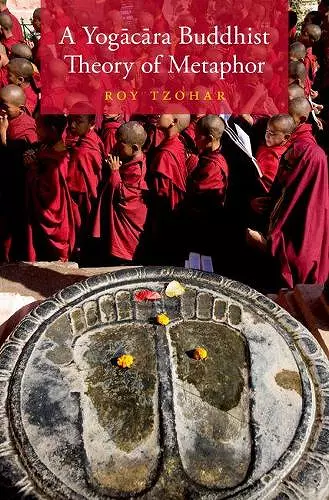
Buddhist philosophy is fundamentally ambivalent toward language. Language is paradoxically seen as both obstructive and necessary for liberation. In this book, Roy Tzohar delves into the ingenious response to this tension from the Yogācāra school of Indian Buddhism: that all language-use is metaphorical. Exploring the profound implications of this claim, Tzohar makes the case for viewing the Yogācāra account as a full-fledged theory of meaning, one that is not merely linguistic, but also applicable both in the world as well as in texts. Despite the overwhelming visibility of figurative language in Buddhist philosophical texts, this is the first sustained and systematic attempt to present an indigenous Buddhist theory of metaphor. By grounding the Yogācāra pan-metaphorical claim in a broader intellectual context, of both Buddhist and non-Buddhist schools, the book uncovers an intense philosophical conversation about metaphor and language that reaches across sectarian lines. Tzohar's analysis radically reframes the Yogācāra controversy with the Madhyamaka school of philosophy, sheds light on the Yogācāra application of particular metaphors, and explicates the school's unique understanding of experience.
The content of this book is well structured, while the writing is succinct and erudite. This is a seminal work in the study of YogÄcÄra thought, as well as an important addition to the fields of Indian philosophy, philosophy of language, and, more broadly, in Buddhist studies. * Nelson Landry, Religious Studies Review *
a seminal work in the study of Yogācāra thought, as well as an important addition to the fields of Indian philosophy, philosophy of language, and, more broadly, in Buddhist studies. * Nelson Landry, Religious Studies Review *
This work is a philosophically technical treatment appropriate for scholars of Yogācāra and Mahāyāna thought generally, as well as those interested in how language is addressed by Indian Buddhist thinkers. It is a challenging work in its detailed progression through the relevant texts, but the architectonic is very clear and provides careful guidance through these issues. * Richard K. Payne, Canadian Journal of Buddhist Studies *
By refusing to bracket the soteriological concerns of Buddhist philosophers while nevertheless putting them in philosophical English, Tzohar invites philosophers into a new conversation where the stakes are in fact quite high. That he is able to do this while staying true to the unfamiliar intuitions sometimes expressed in Indian Buddhist and non-Buddhist traditions is an admirable accomplishment. * Journal of Religion *
Rare is the academic monograph that combines the precision of painstaking textual and conceptual analysis with the kinds of dazzling and innovative insights that have the capacity to give rise to many new areas of inquiry in an already established field. Such is what Roy Tzohar accomplishes in A Yogacara Buddhist Theory of Metaphor...Because this book both breaks new ground, and does so in a methodical, comprehensive, and intellectually challenging fashion, itis essential reading for students of Yogacara thought and South Asian philosophy of language, and is to be highly recommended to students of Buddhist philosophy more generally. * Joy Brennan, Kenyon College, Journal of Buddhist Ethics *
Roy Tzohar's volume, the first study of its kind in English, provides a detailed yet accessible analysis of early Indian philosophy of language in general, and Yogācāra theory of metaphor (upacāra) in particular. The result is a stunning integration of philosophical sophistication and philological rigoran invaluable contribution not only to our understanding of early Indian theories of language, but also to our appreciation of Yogācāra thought. * Robert H. Sharf, D.H. Chen Distinguished Professor of Buddhist Studies, University of California, Berkeley *
In this magnificent and trailblazing book Roy Tzohar reconstructs a Buddhist philosophical defense of the radical thesis that all language is metaphor. The manner in which he does thisshowing that Buddhist thinkers had sophisticated indigenous theoretical tools to argue for their claim, situating the Buddhist view in a proper intellectual context comprising contemporaneous non-Buddhist philosophers, and rehabilitating one particular Buddhist, Sthiramati (470550), as a strikingly innovative thinker in his own rightis methodologically exemplary. A tremendous achievement. * Jonardon Ganeri, author of Attention, Not Self *
Scholars both traditional and modern have been slow to recognize the significance and innovation in the works of Sthiramati, a brilliant sixth-century Indian Buddhist philosopher of the Yogācāra school. Tzohar's fascinating work brings Sthiramati's contributions to light by locating them in the philosophical conversations of their time and tradition. In addition, Tzohar traces the logic in familiar philosophical terms, showing how Sthiramati's approach to language, reality and meaning is significant for our time as well. * Jonathan C. Gold, author of Paving the Great Way: Vasubandhu's Unifying Buddhist Philosophy *
[T]he book is an extremely valuable and insightful contribution to the study of Indian theories of language and meaning...In sum, Tzohar's book presents an innovative approach that shows how Yogacāra Buddhist philosophers developed their views in close interaction with non-Buddhist and non-Mahāyāna thoughts on language and epistemology. Obviously sympathetic with Sthiramati, Tzohar develops a reconstruction of the pan-metaphorical theory that he personally finds convincing. As such, the work can also be located in the field of comparative philosophy. * Reading Religion *
- Winner of Winner, 2022 Kadar Family Award for Outstanding Research, Tel Aviv University Winner, 2018 Toshihide Numata Book Award.
ISBN: 9780190664398
Dimensions: 157mm x 239mm x 23mm
Weight: 499g
296 pages