Mapping the Afterlife
From Homer to Dante
Format:Hardback
Publisher:Oxford University Press Inc
Published:22nd Jun '20
Currently unavailable, currently targeted to be due back around 12th August 2026, but could change
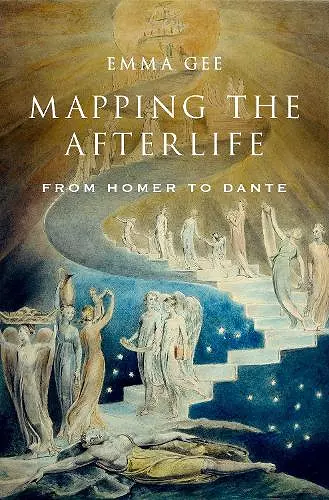
There are very few accounts of the afterlife across the period from Homer to Dante. Most traditional studies approach the classical afterlife from the point of view of its "evolution" towards the Christian afterlife. This book tries to do something different: to explore afterlife narratives in spatial terms and to situate this tradition within the ambit of a fundamental need in human psychology for the synthesis of soul (or "self") and universe. Drawing on the works of Homer, Plato, Cicero, Virgil, and Dante, among others, as well as on modern works on psychology, cartography, and music theory, Mapping the Afterlife argues that the topography of the afterlife in the Greek and Roman tradition, and in Dante, reflects the state of "scientific" knowledge at the time of the various contexts in which we find it. The book posits that there is a dominant spatial idiom in afterlife landscapes, a "journey-vision paradigm"--the horizontal journey of the soul across the afterlife landscape, and a synoptic vision of the universe. Many scholars have argued that the vision of the universe is out of place in the underworld landscape. However, looking across the entire tradition, we find that afterlife landscapes, almost without exception, contain these two kinds of space in one form or another. This double vision of space brings the underworld, as the landscape of the soul, into contact with the "scientific" universe; and brings humanity into line with the cosmos.
Landscapes of the underworld, though imaginary, also stand in definite relation to the real world of the living. This principle - simple in itself, complex in its manifestations - lies at the heart of Emma Gee's fascinating and imaginative Mapping the Afterlife ... The book's title understates its scope and ambition. * Mark F. McClay, Hillsdale College, ARYS: Antiquity, Religions and Societies *
What Gee has done is an impressive and valuable addition to existing scholarship on views of the afterlife. Her effort to map the afterlife in all its complexity and nuance is a valuable model for other scholars, and provides an important guidebook for navigating the foreign terrain of the afterlife. * Michael Asher Hammett, Columbia University, Ceræ: An Australasian Journal of Medieval and Early Modern Studies *
This is indeed a fascinating, well-argued study that sheds much light on spaces both well-trod and too rarely interconnected. * Benjamin Eldon Stevens, Bryn Mawr Classical Review *
This is an inspiring and unprecedented book. The official topic is the afterlife in the ancient world and beyond, but Emma Gee clearly shows that narratives about the afterlife are ultimately about our self, and the way we perceive and understand the world around us. * Gabriele Galluzzo, University of Exeter *
Gee's exploration of 'the shadowland where science and soul meet' is revelatory, sweeping aside modern myths and explaining ancient ones with erudition and imagination. The precision of her new readings of some of themost studied passages of classical and medieval literature is matched by the extraordinary lucidity of her prose. This is a landmark study. * Greg Woolf, Institute of Classical Studies, University of London *
ISBN: 9780190670481
Dimensions: 155mm x 236mm x 33mm
Weight: 635g
384 pages