Uncertainty in Post-Reformation Catholicism
A History of Probabilism
Format:Hardback
Publisher:Oxford University Press Inc
Published:28th Dec '17
Currently unavailable, and unfortunately no date known when it will be back
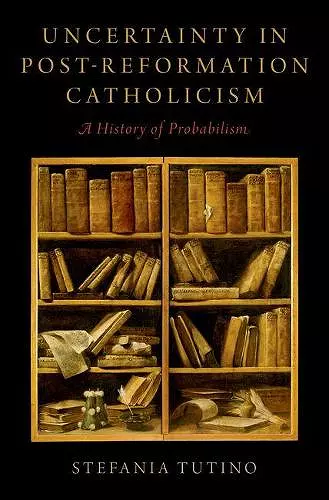
This book provides a historical account of early modern probabilism and its theological, intellectual, and cultural implications. First developed in the second half of the sixteenth century, probabilism represented a significant and controversial novelty in Catholic moral theology. By the second half of the seventeenth century, and thanks in part to Pascal's influential anti-probabilist stances, probabilism had become inextricably linked to the Society of Jesus and to a laxist system of morality, which emphasized and exploited the elasticity of moral rules. To this day, most scholars of early modern religious history either ignore probabilism, or associate it with moral duplicity and intellectual and cultural decadence. Uncertainty in Post-Reformation Catholicism argues that probabilism played a central role in addressing the challenges that a geographically and intellectually expanding world posed to traditional Catholic theology. Early modern probabilist theologians realized that their time was characterized by many changes and novelties that traditional theology was not equipped to deal with, and that consequently provoked an exponential growth of uncertainties, doubts, and dilemmas of conscience. These theologians used probabilism as a means to integrate changes and novelties within the post-Reformation Catholic theological and intellectual system. Seen in this light, probabilism represented the result of their attempts to appreciate, come to terms with, and manage uncertainty. The problem of uncertainty was not only crucial then, but remains central even today. Despite the unprecedented amount of information available to us, we are becoming less able to formulate arguments based on facts, and more dependent on a cacophony of opinions that often simply reproduce our own implicit or explicit biases, prejudices, and preconceived preferences.
It is sophisticatedly argued and well-research, and offers a valuable resource for considering the application of probabilism to a legion of different challenges brought about by increases in both new information and uncertainty in the early modern world. * Christopher P. Gillett, Journal of Jesuit Studies *
In UPRC, Stefania Tutino has made an exceptional contribution to the his-tory of early modern moral theology. Advanced students as well as scholars and library collections can profit from this excellent scholarly resource. * Julia A. Fleming, Catholic Historical Review *
Recommended. * B.B. Kensinger, CHOICE *
Tutino's newest book is an eminent contribution to intellectual history, and a necessary antidote to the caricatures of probabilism floating around in handbooks of ethics and theology. This is an exciting reading adventure into a world where uncertainty was not feared but dealt with creatively. * Ulrich L. Lehner, The Regensburg Forum *
ISBN: 9780190694098
Dimensions: 155mm x 239mm x 51mm
Weight: 898g
584 pages