Charles Bonnet, Analytical Essay on the Faculties of the Soul
Format:Hardback
Publisher:Oxford University Press
Published:6th Jan '22
Currently unavailable, and unfortunately no date known when it will be back
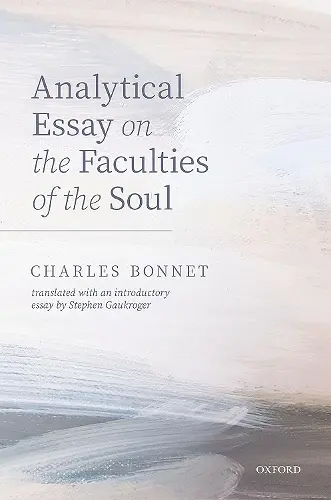
In the course of the eighteenth century, understanding human cognitive life came to be construed as something to be explored in terms of the physiology of the sensory organs, the nerves, and the brain: a form of naturalization that effectively moved cognition out of the realm of philosophy as it had traditionally been understood. Bonnet's Analytical Essay on the Faculties of the Soul was at the forefront of these developments, and this is its first English translation. Drawing on his earlier work in natural history--he was the leading entomologist of his era--he approaches problems of the nature of the mind via the physiology and anatomy of the brain and sensory systems. His approach is one of 'reverse engineering', starting from an organic statue without faculties, and investigating how it would need to be modified to produce a human being. Bonnet takes up a position that cuts across the standard understanding of the period as a clash between materialism and dualism. While his approach was rigorously naturalistic and physiological, this did not lead him to reject the notion of a soul. Instead, he argues that, in order to make sense of their sensory abilities, we need to attribute a soul to animals as well as human beings. At the same time, he argues that if personal immortality is to be possible, it can be conceived along the lines of insect metamorphosis, which shows how different biological forms can harbour a single identity.
Bonnet's is an important and courageous text, well deserving of translation and commentary. * Catherine Wilson, Annal of Science *
Whether or not one agrees with Bonnet's account and method of inquiry, this work is of great importance, and Gaukroger (emer., Univ. of Sydney, Australia) is to be commended for such a wonderful translation. * A. Jaeger, CHOICE *
The English translation is finely produced, with a deft rendering from the original French of Bonnet's style of exposition, familiar to this reader from encounters with his other massive tomes in the original language. The apparatus is effective, and the bibliography, very helpful. Gaukroger's introduction does a fine job of situating the work in context, especially in the line from Descartes to Locke, Étienne Bonnot de Condillac, and the development of sensationalist and associationist theory of mind....Anglophone students of the Enlightenment should be grateful for Gaukroger's translation. * John H. Zammito, Notre Dame Philosophical Reviews *
ISBN: 9780192846778
Dimensions: 240mm x 161mm x 20mm
Weight: 558g
270 pages