The False Promise of Superiority
The United States and Nuclear Deterrence after the Cold War
Format:Paperback
Publisher:Oxford University Press Inc
Published:13th Mar '23
Should be back in stock very soon
This paperback is available in another edition too:
- Hardback£98.00(9780197680865)
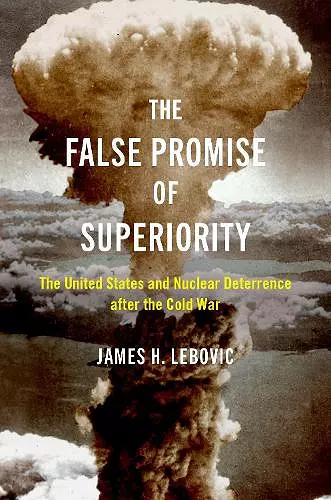
This political analysis exposes the fanciful logic that the United States can use nuclear weapons to vanquish nuclear adversaries or influence them when employing various coercive tactics. During the Cold War, American policymakers sought nuclear advantages to offset an alleged Soviet edge. Policymakers hoped that US nuclear capabilities would safeguard deterrence, when backed perhaps by a set of coercive tactics. But policymakers also hedged their bets with plans to fight a nuclear war to their advantage should deterrence fail. In The False Promise of Superiority, James H. Lebovic argues that the US approach was fraught with peril and remains so today. He contends that the United States can neither simply impose its will on nuclear adversaries nor safeguard deterrence using these same coercive tactics without risking severe, counterproductive effects. As Lebovic shows, the current faith in US nuclear superiority could produce the disastrous consequences that US weapons and tactics are meant to avoid. This book concludes that US interests are best served when policymakers resist the temptation to use, or prepare to use, nuclear weapons first or to brandish nuclear weapons for coercive effect.
James Lebovic's The False Promise of Superiority is a real breath of fresh air that makes a vital contribution to ongoing debates about nuclear strategy, especially the nature, meaning and significance of nuclear 'superiority.' Challenging approaches to nuclear strategy that rely on capabilities rather than intentions and real-world decision-making dynamics, Lebovic makes a compelling case that nuclear strategists and policy makers should focus on what potential adversaries are likely to do as opposed to what they can do. No one interested in the future of nuclear deterrence and strategy can afford to ignore this provocative and important book. * Keith Shimko, Purdue University *
James Lebovic provides an unsparing examination of lessons learned and unlearned from debates about nuclear deterrence during the Cold War. More importantly, he demonstrates why these debates are relevant today as the United States struggles to deal with the nuclear challenges posed by Russia, China, Iran, and North Korea. At a time when most analyses of nuclear deterrence and strategic stability focus on the impact of emerging technologies, Lebovic focuses on the underlying logic of how deterrence works and makes a strong case that capabilities matter much less than commonly supposed. His analysis is a useful antidote to the current fascination with how artificial intelligence, hypersonic missiles, and cyber weapons will revolutionize deterrence. * Gregory Koblentz, Associate Professor and director of the Biodefense Graduate Program, George Mason University *
The False Promise of Superiority is an important book that reminds readers how the faulty logics and irrationalities of the Cold War era continue to haunt the present. * Choice *
This book remains extremely relevant in today's times. A significant segment of today's US nuclear strategists continues to recommend strategies similar to those of the Cold War era. * Peter Nazarechuk, H-Net *
ISBN: 9780197680872
Dimensions: 154mm x 236mm x 17mm
Weight: 422g
288 pages