Ctrl+Alt+Doubt
Decoding the Language of Online Conspiracy Talk
Henrich R Greve author Hayagreeva Rao author
Format:Paperback
Publisher:Oxford University Press Inc
Publishing:5th Nov '26
£19.99
This title is due to be published on 5th November, and will be despatched as soon as possible.
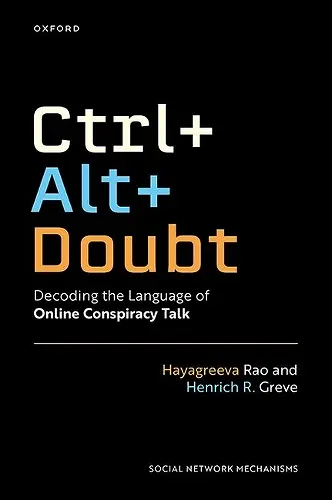
Conspiracy theories are as old as society^—^but never have they spread so fast or so visibly. In an age of social media, moments of crisis and conflict ignite waves of conspiratorial storytelling that reshape how people interpret events, assign blame, and mobilize action. Ctrl+Alt+Doubt offers a new way to understand why conspiracy theories grow and persist. Rather than treating them as cognitive errors, psychological pathologies, or products of echo chambers, Rao and Greve analyze conspiracy theories as linguistic constructions^—^stories built from recognizable semantic patterns. Using tools from distributional semantics, they map the semantic space of conspiracy talk and show how meanings are assembled, recombined, and diffused online. Drawing on cases from COVID-19 and the Black Lives Matter protests, Rao and Greve show that conspiracy theorizing is a form of bricolage: people tinker with cultural fragments to craft explanations that reduce uncertainty and threat. New conspiracy beliefs are most likely to take hold when they are linguistically close to beliefs people already hold. The book traces how conspiracy theories spread through superspreaders, fear-laden language, bots, and shared hashtags^—^revealing conspiracy theorizing as a form of proto-coordination that generates community, amplifies outrage, and enables collective sensemaking among opponents of social movements. By foregrounding language and interaction, Ctrl+Alt+Doubt bridges cultural sociology, computational linguistics, and diffusion theory^—^offering a powerful framework for understanding how conspiracy theories spread and how interventions might be designed to blunt their social harm.
CTRL+ALT+DOUBT delves into the digital age of doubt we're living through, tracing how conspiracy theories flourish not among the fringe, but across everyday online conversations. Sparked by the global upheaval of COVID-19, this sociological study investigates how distributed skepticism-fueled by uncertainty and shared online-shapes meaning-making on the margins. This is a wonderful examination of how we got to this place, and why conspiracy theories have such enduring appeal. It's essential reading for students, scholars, and anyone seeking to understand how truth, trust, and collective reasoning evolve in our hyperconnected world. Charles Duhigg, author of Supercommunicators and The Power of Habit
Focusing on the emergence and spread of COVID conspiracy theories from the onset of the pandemic through its politicization and polarization in summer 2020, Control+Alt+Doubt provides a fresh and eclectic view of a timely topic - the etiology and careers of online conspiracy theories and the people who spread them - and demonstrates the value of taking language seriously. Paul DiMaggio, Professor of Sociology at New York University
Finally, a cultural sociology of conspiracy theories! Though many studies examine how fringe narratives spread across social networks-and how they interact with psychological attributes of the individuals who comprise them-we still lack a comprehensive understanding of how the language of such messages fits into the broader patchwork if meaning-making and ideology in modern democracies such as the United States. Rao and Greve breathe new life into this topic by explaining how conspiracy theorists can be understood as problem solvers who craft narratives that resolve contradictions and create durable bonds between those outside the mainstream. This book will not only be of great interest to cultural sociologists who crave a deeper understanding of misinformation, but also all social scientists eager to understand how modern text analysis approaches might be used to unlock new insights about such cutting-edge topics. Highly recommended. Chris Bail, Professor of Sociology at Duke University
Rao and Greve have written a timely book for an era in which conspiracy theories are influencing public policy on numerous fronts. Arguing that conspiracy theories have cultural and linguistic fingerprints, the authors use computational models to analyze tweets about Covid-19 and George Floyd's murder to reveal the paths by which people fall down rabbit holes of conspiracy. We learn that people do not become “superspreaders” because they voice a conspiracy repeatedly, but because of their unique position in a social network. Rao and Greve demonstrate the promise of computational social science and shed light on how we might go about countering conspiracists. Steve Barley, Professor Emeritus of Technology Management at UCSB's College of Engineering
Rao & Greve unpack the linguistic structure that underlies the widespread diffusion of conspiracy theories. Rather than focusing on conspiracy theorists - which prior work unhelpfully characterizes as various forms of deplorable - Rao and Greve focus on the semantic content of theories. They deftly show how the linguistic form of conspiracy theories provide an epistemic foothold for the dispossessed to understand their situation at the edges of social structure, while an interactive “dialogic dance” of participants within the genre reifies distributed doubt and builds an affirmative outsider culture. Conspiracy theories are attractive because they provide both explanation and belonging. Through richly detailed case studies of Covid-19 and Black Lives Matter conspiracies, they provide a masterclass in contemporary sociological analysis of text, resulting in a book that integrates theory and data for new insights. James Moody, Professor of Sociology at Duke University
ISBN: 9780197772294
Dimensions: 234mm x 159mm x 10mm
Weight: 268g
176 pages