Neanderthals
Fact, Fiction, and Wishful Thinking
Format:Hardback
Publisher:Oxford University Press Inc
Publishing:22nd Oct '26
£25.99
This title is due to be published on 22nd October, and will be despatched as soon as possible.
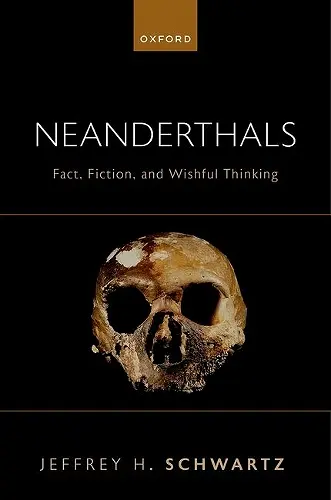
In the early 20th century, paleoanthropologists interpreted the oft-profound differences between specimens of an expanding human fossil record as reflecting taxonomic and evolutionary diversity. Why, then, in the 1940s, did geneticist Theodosius Dobzhansky reconfigure human evolution into one, profoundly morphologically variable lineage which changed slowly through time? Neanderthals: Fact, Fiction, and Wishful Thinking exposes, for the first time, the history of how conceptions of race have configured interpretations of the first-found human fossils; how assumptions underlying human fossils were and still are interpreted as to species and their evolutionary relationships. No matter how "different" Nazis thought living humans were, differences between Neanderthals and bigger-browed, chunkier-faced specimens and living humans trivialized the differences between living humans. In 1950, without basis, taxonomist Ernst Mayr lumped all fossil and extant humans into three transforming species of genus Homo: transvaalensis>erectus>sapiens; sapiens subsumed humans, Neanderthals, and even less morphologically sapiens-like specimens. In 1962, at a Wenner-Gren Foundation meeting, participants-mostly geneticists and behaviorists, unfamiliar with the human fossil record-voted to keep these specimens, Neanderthals, and humans in Homo sapiens. Even when Neanderthals were returned to species neanderthalensis, the assumption remained: humans and Neanderthals interbred. When a Neanderthal nuclear DNA sequence was cobbled together and compared to human nDNA, molecular anthropologists could claim humans received "genes" identified in Neanderthal DNA via interbreeding. In its press release, the Committee that awarded Svante Pääbo the Nobel Prize for "demonstrating" human inheritance of Neanderthal "genes" made clear that his claims were predicated on assuming Neanderthal-human interbreeding. It's remarkable how received wisdom continues to influence paleoanthropologists and molecular anthropologists who then present as fact, to a naïve public, assumptions that are biologically and evolutionarily wrong.
With his decades of learning and expertise, paleontologist Jeffrey Schwartz pushes back against media headlines that [Neanderthals] were "just like us" as he takes a bold stance against the thesis – including by Svante Pääbo - of Paleolithic interbreeding. Beyond the battle between morphology and molecules, Schwartz expertly leads us through the history of taxonomy and evolutionary theory from Darwin to the "Modern Evolutionary Synthesis" to paleogenomics... he shows how received wisdom born of post-war anti-racism has misshaped our understanding of hominid diversity... * Peter Sahlins, author of Neanderthals Among Us *
ISBN: 9780197785409
Dimensions: unknown
Weight: unknown
280 pages