Capitalism in South Korea, 1945–2025
Compressed Development, Decompression, and Diverging Convergence
Keun Lee author Djun Kil Kim author
Format:Hardback
Publisher:Oxford University Press Inc
Published:12th Oct '26
Should be back in stock very soon
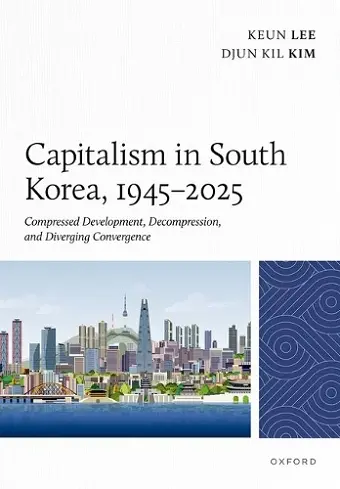
Capitalism in South Korea, 1945–2025 provides an interdisciplinary and analytical account of the evolution of South Korea since 1945. This book employs a framework of "compressed development, decompression, and convergence" to better understand Korea's turbulent journey, which has been marked by economic miracles, crises, and, more recently, a slowdown in growth and rising inequality. The book begins by defining "decompression" as political democratization and economic liberalization while demonstrating that economic achievements under the regime of compressed growth enabled the emergence of a Korean middle class that demanded political freedom, facilitating a peaceful transition to democracy in the late 1980s. Capitalism in South Korea, 1945–2025 then goes on to show how the post-crisis reforms imposed by the IMF set Korea on a trajectory of convergence with Anglo-American capitalism and brought an end to the so-called "East Asian miracle". This book highlights the unexpected co-existence of two different paths of convergence displayed by Korea. The first path involves convergence with Anglo-American capitalism, which is characterized by slow growth, worsening inequality, and "free but not-so-clean" democracy. The second path is convergence with the "safe capitalism" of several continental European countries, which is typified by low birth rates, low divorce and crime rates, and long-life expectancy, as well as the pursuit of active labor market policies emulating Northern Europe. Capitalism in South Korea, 1945–2025 concludes that contemporary Korea is undergoing a period of "diverging convergence". That is, Korea shows some signs of converging with certain advanced capitalist nations while also remaining distinct according to various indicators.
“South Korea is the most dramatic example of transition in world history. This is economic, but it is also political and social. How did this happen and what does this tell us about the big ideas of social theory? This passionate and authoritative book answers both these questions and more.” * James Robinson, Nobel Laurate in Economic Science; University Professor, University of Chicago *
“Capitalism in South Korea is not just another narrative of the country's rapid growth; it is much more ambitious than that. Lee and Kim offer a broad and novel political economy that locates the rapid growth phase on both authoritarian politics and distinct forms of state intervention. They show how economic successes set the stage for democratization but also an unfortunate convergence on an Anglo-American model of capitalism. That model has a number of disabilities * slower growth, rampant inequality and corruption-that define the country's current policy agenda. A masterful treatment.” Stephan Haggard, Distinguished Research Professor, University of California San Diego *
“This book offers an invaluable contribution to the debate on the turbulently dynamic transformation of South Korean capitalism and society. Its argument does not derive from a mechanical polemical approach against neoclassical views, but from a comprehensive, open-minded consideration of objective realities in the economy, politics, and society. The authors systematically grasp at the unprecedented and unparalleled complexities of South Korean trajectories of macroeconomic and social structural conditions in the 21st century.” * Chang Kyung-Sup, SNU Distinguished Professor of Sociology, Seoul National University *
ISBN: 9780197852989
Dimensions: 237mm x 165mm x 19mm
Weight: 481g
216 pages