Are Some Languages Better than Others?
Format:Hardback
Publisher:Oxford University Press
Published:24th Mar '16
Currently unavailable, and unfortunately no date known when it will be back
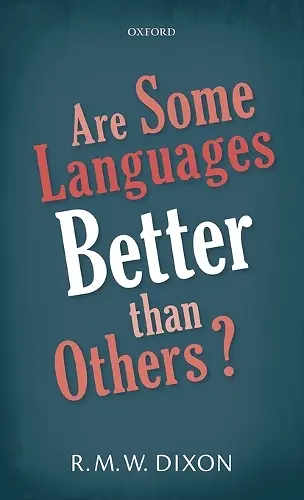
This book sets out to answer a question that many linguists have been hesitant to ask: are some languages better than others? Can we say, for instance, that because German has three genders and French only two, German is a better language in this respect? Jarawara, spoken in the Amazonian jungle, has two ways of showing possession: one for a part (e.g. 'Father's foot') and the other for something which is owned and can be given away or sold (e.g. 'Father's knife'); is it thus a better language than English, which marks all possession in the same way? R. M. W. Dixon begins by outlining what he feels are the essential components of any language, such as the ability to pose questions, command actions, and provide statements. He then discusses desirable features including gender agreement, tenses, and articles, before concluding with his view of what the ideal language would look like - and an explanation of why it does not and probably never will exist. Written in the author's usual accessible and engaging style, and full of personal anecdotes and unusual linguistic phenomena, the book will be of interest to all general language enthusiasts as well as to a linguistics student audience, and particularly to anyone with an interest in linguistic typology.
A veritable compendium of linguistics, a collection of concise but detailed information about the essential components of human languages. It is written in an accessible, enjoyable, and refreshingly clear style. It also brings many other important questions into focus, for example, the varying extents to which speakers of diverse tongues make use of the vast potential resources of human language. * Lars Johanson, Language *
Too many linguists are afraid to pose the question that makes up the title of this book. Like people, languages are different, and each has its own strengths and weaknesses; some are harder to figure out, and some are relatively easy. Dixon illustrates these facts in a very clear and engaging manner, using examples from a wide variety of languages from around the world, and though delightful anecdotes taken from his fifty years of experience in the field. This is a book based in linguistic reality, not linguistic theory. * Aaron D. Rubin, Pennsylvania State University *
The (in)equality of languages is certainly one of the most vexing issues in modern linguistics. This book effectively challenges some common views on language, ranging from those pertaining to feelings of western cultural superiority to the 'politically correct' convictions prevalent among traditional academic circles. The author offers a balanced and well-informed discussion of the issue and draws from a lifelong research experience with languages of all types, spoken in situations that can differ dramatically. A very refreshing approach that will keep the reader fascinated. * Willem F. H. Adelaar, Leiden University *
ISBN: 9780198766810
Dimensions: 222mm x 144mm x 22mm
Weight: 458g
288 pages