James Joyce and the Phenomenology of Film
Format:Hardback
Publisher:Oxford University Press
Published:6th Jul '17
Currently unavailable, and unfortunately no date known when it will be back
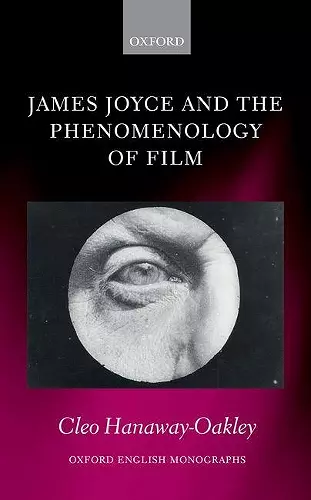
James Joyce and the Phenomenology of Film reappraises the lines of influence said to exist between Joyce's writing and early cinema and provides an alternative to previous psychoanalytic readings of Joyce and film. Through a compelling combination of historical research and critical analysis, Cleo Hanaway-Oakley demonstrates that Joyce, early film-makers, and phenomenologists (Maurice Merleau-Ponty, in particular) share a common enterprise: all are concerned with showing, rather than explaining, the 'inherence of the self in the world'. Instead of portraying an objective, neutral world, bereft of human input, Joyce, the film-makers, and the phenomenologists present embodied, conscious engagement with the environment and others: they are interested in the world-as-it-is-lived and transcend the seemingly-rigid binaries of seer/seen, subject/object, absorptive/theatrical, and personal/impersonal. This book re-evaluates the history of body- and spectator-focused film theories, placing Merleau-Ponty at the centre of the discussion, and considers the ways in which Joyce may have encountered such theories. In a wealth of close analyses, Joyce's fiction is read alongside the work of early film-makers such as Charlie Chaplin, Georges Méliès, and Mitchell and Kenyon, and in relation to the philosophical dimensions of early-cinematic devices such as the Mutoscope, the stereoscope, and the panorama. By putting Joyce's literary work--Ulysses above all--into dialogue with both early cinema and phenomenology, this book elucidates and enlivens literature, film, and philosophy.
Readers and critics interested in contemporary critical and theoretical approaches to art and literature will certainly be gratified by Cleo Hanaway-Oakley's book ... James Joyce and the Phenomenology of Film offers readers thoughtful insights into Joyce's strategy as they relate to the philosophical dimensions of showing. * Margot Norris, James Joyce Literary Supplement *
Cleo Hanaway-Oakley's short, but rigorous study James Joyce and the Phenomenology of Film responds to what she sees as a lack of engagement with phenomenology in literary studies in comparison to film studies. Choosing not to highlight analogous techniques between Joycean modernism and film, or draw relationships of influence between Joyce, film, or phenomenology, Hanaway-Oakley instead carefully reveals and illumines what she delineates as 'parallel philosophies latent within early cinema spectatorship, within early films themselves, and within Joyce's texts and the experience of reading Joyce'stexts' (p. 3). * The Year's Work in English Studies *
Reading Joyce back through a highly original synthesis of phenomenology, early cinema and film theory, this is a genuinely comparative study that challenges longstanding ideas around modernism and film, and points the way towards future studies of literary modernism that bring together history, philosophy and non- textual media forms. * Peter Adkins, Textual Practice *
impressively researched, methodically-organised and, above all, admirably readable ... [this] monograph deserves to become a milestone in Joyce and film studies and I cannot recommend it highly enough. * Keith Williams, James Joyce Broadsheet *
ISBN: 9780198768913
Dimensions: 223mm x 144mm x 15mm
Weight: 328g
160 pages