Oxford Handbook of Clinical Diagnosis
Format:Part-work (fascículo)
Publisher:Oxford University Press
Publishing:25th Mar '27
£34.99
This title is due to be published on 25th March, and will be despatched as soon as possible.
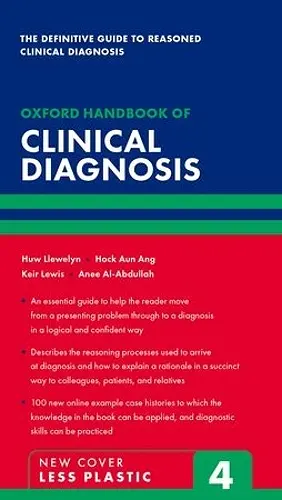
The Oxford Handbook of Clinical Diagnosis, Fourth Edition, is a leading guide to help the medical trainee move from a presenting problem to a well-reasoned diagnosis. It also describes how to explain such a rationale clearly and confidently to other doctors, examiners, and also patients and relatives. This ground-breaking, and practical handbook identifies the possible results of the history, preliminary tests, and examination that can be used as a 'lead' with a manageable list of differential diagnoses. Combinations of findings can then be found in succinctly worded tables that can be scanned quickly for a diagnosis compatible with the patient's findings, and the presenting complaints. Readers can also test what they have learnt by hiding parts of the tables before trying to recall the differential diagnoses and confirmatory findings. This flexible approach is different to that of starting with one broad finding (e.g. 'chest pain') and being led through a long list of diagnostic possibilities displayed by fixed flow charts. The book concludes with a chapter that analyses traditional diagnostic reasoning in great detail, and how it can use modern technology. This fully revised fourth edition is aimed primarily at medical students and resident doctors who wish to improve their diagnostic skills and is now accompanied by 100 online example case histories to which the knowledge in the book can be applied, and diagnostic skills can be practiced. It provides all doctors with a rapid, succinct revision source and practical help when dealing with undifferentiated problems outside their immediate field of expertise. It also provides more senior doctors with examples, and a framework to help teach trainees to approach diagnostic problems logically, and to justify their opinions in a structured way. This can avoid breakdowns in communication that are so common in today's multi-disciplinary care.
Review from previous edition This is a nice memory aid for new clinicians as well as a refresher for clinicians who have been in the practice of medicine for a long time. * Doody's Notes *
This book is useful for medical students of all years... and is perfect for ILAs, finals revision and wards round. As with all Oxford Handbooks, its handy size makes it very placement friendly. * North Wing *
It is pitched perfectly for the student studying for undergraduate clinical exams and for the general practice specialist training knowledge test. It would also serve as a helpful aide memoir for doctors dealing with a patient presenting with a problem outside their speciality. * British Journal of Hospital Medicine *
The idea is brilliant - take symptoms, signs, and examination findings, and suggest the most likely diagnosis. Then discuss how best to confirm it...once again OUP have come up trumps with another fine addition to the handbook family. * Dr Jeremy Sagar, Univadis *
Whether you use its easy layout and concise size as a quick reference on wards or as a key text on those differential diagnosis questions in your private study, this book aims to help you come to terms with one of the hardest skills known to medical students. * Steve Knight, Year 4 Intercalating Student, Leicesterscrubs.com *
a beneficial addition to any medical ward either at the nurses' station or in the doctors' office...would recommend this book for consultation at ward level. * AS Fitzpatrick, Marchall Riley *
ISBN: 9780198809760
Dimensions: unknown
Weight: unknown
696 pages
4th Revised edition