Nietzsche on the Decadence and Flourishing of Culture
Format:Hardback
Publisher:Oxford University Press
Published:2nd May '19
Currently unavailable, and unfortunately no date known when it will be back
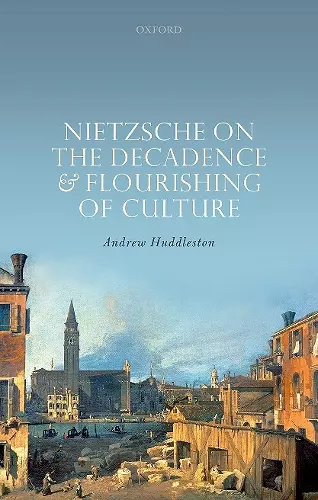
In Nietzsche's first book The Birth of Tragedy (1872), cultural renewal is paramount among his concerns. In the person of Richard Wagner, Nietzsche saw someone who might bring together a fragmented and directionless modern society through the creation of tragic festival that, through its mythic content, would allegedly give renewed meaning and purpose to human life. The standard story about Nietzsche's philosophical development is that he becomes disillusioned with this project and his mature philosophy undergoes a radical shift. Instead of reposing his hopes in a broader culture, he comes to occupy himself instead with the fate of a few great individuals, or, at the extreme, perhaps mainly with his own quasi-artistic self-cultivation. On these readings, to the extent that he remains concerned with culture at all, it is only as something whose noxious influence threatens this cadre of elite individuals. Nietzsche on the Decadence and Flourishing of Culture questions this individualist reading that has become prevalent, and develops an alternative interpretation of Nietzsche as a more social thinker who sees collective cultural achievements as no less important. Great individuals are not all that matter. Andrew Huddleston uses Nietzsche's perfectionistic ideal of a flourishing culture and his diagnostics of cultural malaise as a point of departure for reconsidering many of the central themes in Nietzsche's ethics and social philosophy, as well as for understanding the interconnections with the form of cultural criticism that was part and parcel of his distinctive philosophical enterprise.
Andrew Huddleston's Nietzsche on the Decadence and Flourishing of Culture is an impressive book: It is sophisticated, yet light-footed and elegant. It is historically ambitious, yet systematically rich. From beginning to end, it is an enjoyable read. * Kristin Gjesdal, Journal of Nietzsche Studies *
The so-called 'continental' side of Nietzsche reception is already very at home with the idea of a 'philosophy of culture', of distinctive modes of cultural hermeneutics, and of Nietzsche as a practitioner and forerunner of such. It is high time that those of us on the more 'analytic' side of things began to explore this side of Nietzsche's work in more depth. Huddleston's book is a rich and promising first move in this direction. * Claire Kirwin, Mind *
I learned a lot from this volume and I commend it to other Nietzsche scholars, especially those thinking about the role of 'culture' in his thought. * Brian Leiter, Notre Dame Philosophical Reviews *
There is a lot to admire in this book. Huddleston's style is at once breezy and precise, staking out its territory pragmatically, robustly, yet without aggression. He combines minute textual analysis with broad-sweeping gestures toward Nietzsche's place in intellectual history, while never losing sight of major critical currents. Most of all, he is careful with his claims, drawing subtle distinctions that will make him harder to misunderstand and that will provoke and further the critical commentary... One of the main messages here—that Nietzsche, as cultural critic, has been ignored for too long—is well taken. For any Anglophone philosophical scholar wishing to write on Nietzsche and culture, this book will—I predict—soon become the first place to look. * Tom Stern, Journal of Nietzsche Studies *
The author pays a great service to a more balanced general comprehension and assessment of Nietzsche... * Carol Chiurco, University of Verona, Nietzsche Circle *
ISBN: 9780198823674
Dimensions: 222mm x 141mm x 17mm
Weight: 360g
206 pages