Designing Organization Design
A Human-Centred Approach
Format:Hardback
Publisher:Oxford University Press
Published:15th Oct '20
Currently unavailable, and unfortunately no date known when it will be back
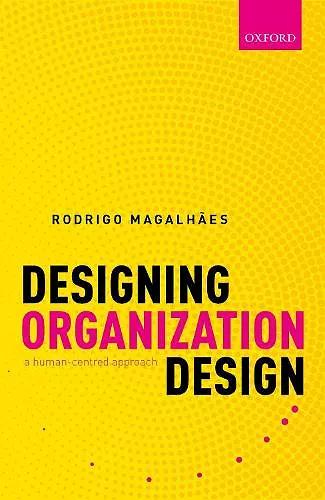
As a topic, organization design is poorly understood. While it is featured in most management books as a chapter dedicated to organizational structures, it is unclear whether organization design is a one-off event or an ongoing process. Thus, it has traditionally been understood to be the same as an organizational configuration, with neat lines of communication and distribution of responsibilities following pre-set typologies. Yet what can be said to constitute organizational structure in this first half of the 21st century? The extraordinary growth of digital communications, the decreasing relevance of hierarchical bureaucracies, and the general demise of command-and-control have all but decimated the traditional notion of organizational structure. Organization design needs a theoretical revamping. Using a mix of design and social science theories and concepts, Rodrigo Magalhães outlines a new human-centric interpretation of design, design principles, and design culture. He puts forward a paradigm where the organization, for purposes of its design, is considered to be a social actor in a permanent state of transformation, with significant repercussions for social and economic life. He also proposes a model of 'leaderful organization design', distinguished as practice-based, guided by values of democratic participation, and driven by design logics which places meaning-making and meaning-taking at the center of organizational life and can be adopted and adapted to suit different environments.
A robust theoretical book ... a valuable read for upper-division undergraduates majoring in leadership, business management, human resources, and industrial/organizational psychology as well as management, human resources development, and business graduate students and faculty. * M. J. Safferstone, CHOICE *
This is a terrific book on organization design. It starts with the premise that organizations are human constructions, purpose driven, and responsive to their stakeholders. In other words this is a practical, common-sense approach that we badly need. Scholars and practitioners will be amply repaid by reading, studying, implementing the ideas in this book. * R. Edward Freeman, University and Olsson Professor, The Darden School, University of Virginia *
This book argues that organization studies need a paradigm shift towards design. Design and organization were always related. However, the current 'design thinking' hype is not the answer, since it does not address the essential issues. In a broader perspective this book presents a carefully reasoned and passionately formulated plea for the urgently needed change from a market society to a society with markets, and it provides useful 'organization design logics' on how to do this. * Wolfgang Jonas, Professor at the Institute for Design Research, Braunschweig University of Art *
This book addresses the urgent need to shift from thinking about organizations purely in terms of structures and systems, offering an alternative approach based on more humane and situated forms. The principles of design thinking and their implications are discussed in depth, and a wide range of literature is drawn on to address the history, current developments, and future possibilities for organization design. Each logic is discussed in detail, taking the reader carefully through its main elements, and key ideas are illustrated and integrated through helpful figures. * Ann L Cunliffe, Professor of Organization Studies, FGV-EAESP, Brazil *
In this era of turbulent change, resulting from emergent technological possibilities, climate change, populism and the like, organizations need to reinvent themselves as well as their role in society. They need to reinvent the way they design themselves day after day on an ongoing basis. Although, as Magalhães points out, we are still waiting for a unified theory of organizational design, we now have a foundational book to help build such theory. Magalhães guides us in a fascinating journey through the landscapes of design as a living and polyedric process. A great organizational read. * Miguel Pina e Cunha, Fundação Amélia de Mello Professor, Nova School of Business and Economics, Universidade Nova de Lisboa *
ISBN: 9780198867333
Dimensions: 236mm x 163mm x 23mm
Weight: 614g
334 pages