Early Scholastic Christology 1050-1250
Format:Hardback
Publisher:Oxford University Press
Published:10th Oct '24
Currently unavailable, and unfortunately no date known when it will be back
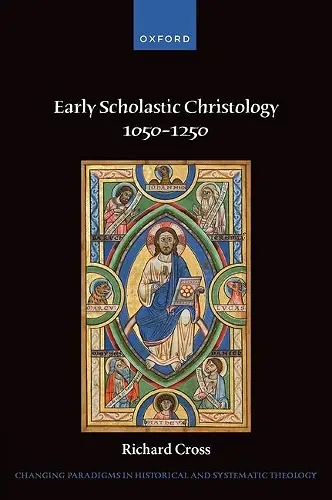
This book traces developments in Christology--and specifically the metaphysics of the union of divine and human natures in one person--from 1050 (the age of Anselm of Canterbury) to 1250 (the age of Albert the Great). During the first part of the period, the key issue is the conflict between Augustine's homo assumptus (assumed man) Christology, defended by the Victorines, and that of Boethius's Chalcedonian Christology, defended by Gilbert of Poitiers (sometimes known as the 'subsistence' theory). By 1180, the latter of these was almost universally accepted. A third view, apparently accepted by Peter Lombard among others, according to which it is not true that Christ as man is something--the non-aliquid Christology--was condemned in 1177. The second part of the book traces the way in which theologians attempted to develop the presentation of Conciliar Christology by working out inchoate solutions to some of the metaphysical questions that the issue raises: what is the nature of the hypostatic union between the two natures, or the human nature and the divine person--is it something created, or something uncreated? And, given that the human nature is a particular substance, what prevents it from being a person? Theologians used insights from both of the rejected theories (the homo assumptus Christology and the non-aliquid Christology) in attempting to answer these issues. The early thirteenth century saw both the founding of the universities of Paris and Oxford, and the founding of the Franciscan and Dominican orders. The book explores the impact of these religious identities on the formation of Christological teaching.
This learned volume is an incalculably valuable resource for students and scholars of church history and theology. * M. A. Schatkin, Choice *
The volume constitutes a significant and high-quality contribution to the study of medieval theology, offering clarity and depth that are rarely matched in the secondary literature. It provides a comprehensive and systematic picture of the early-scholastic Christological debate, capturing its most important moments, providing efficient interpretative tools, and illustrating convincingly its major transformations. It should undoubtedly be recommended to anyone wishing to grapple with one of the most complex theological issues situated within a particularly dynamic period of intellectual history. * Magdalena Bieniak, Church History and Religious Culture *
This book is the fifth in a series of monographs Richard Cross is writing on western Christology. Now spanning the years 1050 to 1700, I know of no better resources for a philosophically sophisticated curation of the theological discussions. * Timothy J. Pawl, Scottish Journal of Theology *
As in all of Cross' books, the scholarship engages the original Latin, is informed by analytic philosophy (congenial to Aristotelian metaphysics), and is of the highest academic caliber. * Mark Mattes, Lutheran Quarterly *
This work is a very important contribution to the history of medieval theology with regard to the metaphysical constitution and linguistic engagement with the Hypostatic Union. * Ulrich G. Leinsle, The Thomist *
This volume is a delight for specialists, and there is no doubt that it, along with the rest of Cross' series, will be of extraordinary benefit to students of Christology for generations to come. * Darren Sumner, Reading Religion *
In Early Scholastic Christology, Cross has done a valuable service to students of medieval Christology, especially those interested in the thought of later theologians, such as St Bonaventure and St Thomas. ...It is my hope that Richard Cross continues to expand his historical-systematic series with further volumes of this kind. * Dylan Schrader, The Heythrop Journal *
ISBN: 9780198936015
Dimensions: 240mm x 162mm x 25mm
Weight: 612g
304 pages