The Oxford Handbook of the Egyptian Economy
Marcelo M Giugale editor Mahmoud Mohieldin editor Racha Ramadan editor
Format:Hardback
Publisher:Oxford University Press
Published:25th Jun '26
Currently unavailable, and unfortunately no date known when it will be back
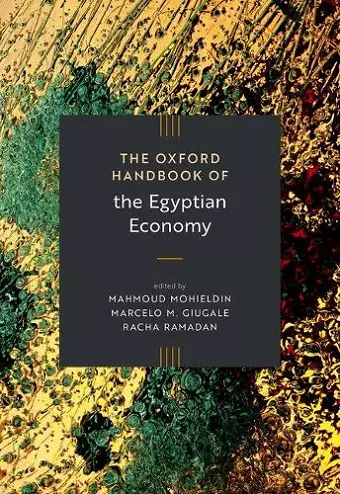
The Oxford Handbook of the Egyptian Economy offers a comprehensive and timely analysis of Egypt's development trajectory, aiming to inform forward-looking policies grounded in evidence and multidimensional research. At its core lies a single guiding question: What would it take to unlock Egypt's full development potential in a way that is more inclusive, sustainable, and resilient to future shocks? The book brings together contributions from over 70 leading experts, researchers, and practitioners to examine the key drivers of Egypt's economic and social outcomes. Structured into six thematic parts, the Handbook delves into the country's macroeconomic fundamentals, sectoral reforms, environmental challenges, and human development priorities. The final section examines institutional reform, governance, social capital, and the megatrends shaping the country's long-term future. This should prove invaluable for government officials, multilateral organizations, academic researchers, students, development practitioners, and all those interested in understanding Egypt's path toward sustainable development.
I had the privilege of working on Egypt as Vice President of the World Bank for the Middle East and North Africa, and I know both its vast potential and its persistent challenges. In this important volume, Mahmoud Mohieldin, Marcelo Giugale, Racha Ramadan and their colleagues bring remarkable clarity and candor to Egypt's development story, while charting a credible path toward a more prosperous, equitable, and sustainable future. Their work is both a sober reminder of the obstacles and an inspiring guide to what Egypt can achieve with bold reform. * Ferid Belhaj, Former VP of Middle East and North Africa-World Bank *
A timely and authoritative work that captures both the complexity of Egypt's economic trajectory and the urgency of charting a path toward sustained, inclusive, and sustainable growth. By bringing together rigorous analyses across macroeconomic stability, sectoral transformation, human capital, social protection, environmental sustainability, and governance, this volume provides not only a comprehensive account of past challenges but also practical insights for future reform. I commend Professors Mahmoud Mohieldin, Marcelo M. Giugale, and Racha Ramadan, together with the distinguished contributors, for producing a reference that will guide scholars, policymakers, and development partners alike in their shared commitment to advancing Egypt's economic future. * H.E. Dr. Hala H. El Said, Former Minister of Planning and Economic Development of Egypt *
This volume is the new key reference for understanding the Egyptian economy, and the essential starting point for a new era of reform and sustainable development in Egypt. The comprehensive volume covers every topic of vital interest - from the underlying sources of Egypt's economic growth to the social and environmental challenges, and the recent record of economic and social reforms. Egypt needs to accelerate its progress. This volume makes clear that success will require a strong focus on education, science and technology; increased government revenues for public investments and services; and stronger trade and investment linkages with economies across Africa, the Mediterranean, the Middle East, the BRICS, and globally. * Jeffrey D. Sachs, University Professor at Columbia University, President of the UN Sustainable Development Solutions Network *
A landmark contribution to understanding one of the Middle East's most important economies, covering every dimension of Egypt's economic landscape. The analyses are rigorous yet accessible, weaving history with current policy debates and pointing toward practical solutions for the future. The result is a sweeping, authoritative, and timely account of Egypt's challenges and opportunities. This book will be indispensable for academics, policymakers, and engaged citizens who wish to understand where Egypt stands today, why it has struggled to reach its potential, and what it will take to build a more prosperous, equitable, and sustainable future. * Ugo Panizza, Pictet Chair in Finance and Development, Geneva Graduate Institute; Vice President, Centre for Economic Policy Research *
This fascinating Handbook offers an unvarnished and multi-faceted diagnosis of why Egypt, despite its tremendous promise, remains locked in a haphazard history of deep crises, missed opportunities, strokes of luck, new beginnings, fleeting triumphs, and dashed hopes. The book provides a judicious mix of sobering analysis and engaging hope. This is a valuable and timely book that provides the necessary analytical roadmap for economists and policymakers to seize this generational moment of technological advances to chart a more prosperous, equitable, and sustainable future for Egypt. It's a must-read, not only for those interested in Egypt, but also for those looking for insights into development economics in practice. * Mohamed A. El-Erian, President of Queens' College, University of Cambridge, and Professor, Wharton School of the University of Pennsylvania *
The Egyptian economy is a classic example of a nation caught on the tarmac, on the verge of take-off for longer than anyone expected. This collection covers an amazing range of perspectives, including covering macroeconomics, governance and politics, and the micro-foundations of the Egyptian economy, to understand this experience. It is bound to be of interest to scholars and policymakers interested not just in the Egyptian case, but development economics in general, and the challenge of economic growth anywhere in the world. * Kaushik Basu, Professor of Economic and Carl Marks Professor of International Studies, Cornell University *
Today, in The Oxford Handbook of the Egyptian Economy, Mahmoud Mohieldin, Marcelo Giugale, and Racha Ramadan, joined by more than sixty distinguished experts, present a comprehensive analysis of Egypt's economic trajectory over the past seventy years. Their work offers valuable insights and policy lessons for Egypt and for the broader region. * Abdallah Al Dardari, UN Assistant Secretary-General and Director of the UNDP Regional Bureau for Arab States *
ISBN: 9780198939047
Dimensions: 252mm x 177mm x 54mm
Weight: 1738g
928 pages