How We Come to Be
Almost Everything That Leads to Our Existence
George F R Ellis author Mauro Carfora author
Format:Hardback
Publisher:Oxford University Press
Published:8th Jun '26
Should be back in stock very soon
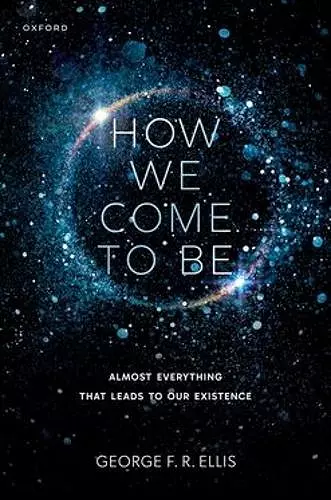
Our existence as living beings - thinking, feeling, acting - is an extraordinary thing: this book provides a scientifically based account of the entirety of factors that lead to our existence. The text begins with the physical foundations of our existence, examining the cosmological context of the vast expanding and evolving universe, enabling the existence of the Sun and the Earth. It goes on to summarise the underlying physics and chemistry, explaining behaviour on an atomic and molecular level, and considers the nature of biological emergence, arguing that all complex systems are modular hierarchical structures, allowing function to emerge at every level, and both upward and downward interactions occur between emergent levels. The book then goes on to examine fundamental processes such as metabolism, dealing with material and energy needs, and homeostasis, stabilising the system against perturbing influences. At the molecular level, this is all enabled by change of shape of macromolecules, and the text looks at how we come into being by a combination of natural selection and developmental processes, which interact with each other and with physiology. Finally, the book discusses the brain and mind, emphasizing the interaction of rationality and emotions, and examining the nature of mental causation and free will. It then delves into existence on a societal level, showing how social institutions having causal powers, and arguing that society can be understood as a homeostatic feedback system relating welfare to social, economic, political, and legal interactions. All social outcomes are determined crucially by our values, the nature of which can be represented by a spectrum of values ranging from very destructive and selfish to very constructive and generous. The final chapter discusses whether meaning exists in the universe, providing evidence that the answer is yes, arguing for moral realism and the existence of a series of abstract possibility spaces that form the deep structure of the cosmos.
A deeply compelling book about how humans came to be in a vast, seemingly unfathomable universe, which also explains how each one of us can find meaning and purpose in our universe. Written by one of the world's leading astrophysicists and humanists, the book deftly guides the general reader through cosmology, biology, history, literature, and social sciences to paint in crystalline prose a picture of the human condition which champions the possibilities for human creativity and free will. The finest attempt to bridge the humanist/literary and scientific cultural divide since Aldous Huxley's Brave New World. * Fen Osler Hampson FRSC, Chancellor's Professor & Professor of International Affairs, Carleton University *
This is a truly remarkable book. It is remarkable for its breadth, scale and insight, but it is also remarkable for its logical structure, clarity, and accessibility. It has brought together an immense body of knowledge from many different disciplines and moulded it into a coherent, compelling account of our existence. Its message about the determinants of our existence has profound significance for how we should seek to influence our evolution. There are few things that can be of greater importance. * Colin Mayer, Professor of Management Studies, University of Oxford *
This must surely be one of the most magnificently interesting and mind-stretching books I have ever read. It has a truly breathtaking ambition, for it aims to show how everything in our lives hangs together - from the galaxies in our universe to the movement of subatomic particles, from materials to living entities, from individuals to societies. Changes at the micro level of atoms, molecules, and genes cause changes at the macro level of organisms and societies, and in reverse, as when the decision to turn on a light leads to a distinctive flow of electrons. George Ellis's effortless familiarity with the natural and social sciences is nothing short of astounding. By explaining how we have agency in a world governed by laws of nature, this book can change the way we view the world and our place in it. * Dennis Snower, President and Founder of the Global Solutions Initiative *
No one else on the planet could have written this book. George Ellis traces how human existence emerges from the fabric of the universe with clarity, depth, and astonishing range - from quantum fields to the human brain, information, and meaning. A truly extraordinary and far-ranging book. A must-read. * Teppo Felin, Anderson Endowed Professor, Utah State University & Associate Scholar, Oxford University *
How We Come to Be is a true tour de force, bringing together clearly and concisely much of what science as a whole has to say about our presence and our place in the universe. At the same time, it presents fresh and challenging views on profound issues such as free will, consciousness, morality, and meaning, restoring a humane and compassionate perspective at the heart of the scientific enterprise. * Philip Ball, Science Writer *
Many readers with backgrounds in physics, the other sciences, or in philosophy, will already know about Ellis's enormous scientific achievements in his original field, cosmology, and also about the range and depth of his more recent work in other fields, such as biology and computer science. In that work, key themes have been emergence, downward causation, and the reality of moral and other values. With this splendid book, Ellis places a keystone at the top of this arch of thought. It is full of detail and passion: learned, thought-provoking, and moving. * Jeremy Butterfield, Trinity College, University of Cambridge *
This book needs to be used for continual reference, providing a rich resource for those working in education. It demonstrates how we came to be through physical foundations, emergent biological levels, and social and personal dimensions. It gives educators in their professional lives, the evidence, language and support needed to take greater agency, which the book argues is key to being human. Examples which aid understanding include upward and downward causation, in addition to symbolic and abstract causation. The book helpfully clarifies the difference between reductionist and integrative approaches in neuroscience which impact on, for example, introducing literacy, and raises questions of whether public policy takes a wrong turn by promoting the former. * Tina Bruce CBE, Honorary Professor, University of Roehampton *
Few physicists have been so impressively engaged in philosophical questions in and beyond physics, and in the questions and challenges confronting wider society. In How We Come to Be, Ellis explores the human condition with style and verve. * Jim Baggott, Logos Consulting Ltd *
How We Come to Be is a good starting point for the ultimate questions of why we are here and what we are for. Professor Ellis brings a magisterial approach, one which recognises the significance of every level of explanation and the bidirectional causal connections between them. Underpinning every page is the understanding that there is a reality which our knowledge seeks to describe accurately - a reality that includes the material but extends beyond it - and that humans have an agency for actions for which they have responsibility. If you want to understand how we emerge from almost everything that leads to our existence, this is the book to read. * Andrew Briggs, Professor Emeritus of Nanomaterials, University of Oxford *
This book is an astonishingly comprehensive summary of the structures of the natural world and of human society, emphasizing how higher-level behaviours emerge in any system composed of vast numbers of interacting parts. The book highlights ethical issues, on which the author has been a moral leader throughout his distinguished scientific career. * Joel Primack, Professor of physics and astrophysics at the University of California, Santa Cruz *
I know of no-one more qualified to address the audacious question of meaning in the universe. George Ellis knows the worlds of mathematics and physics, including cosmology, through a lifetime of front-line research. He has interacted deeply in his collaborations with biologists and philosophers. The outcome is a book of immense depth. Naive reductionism has had its day: here is the book for an age that is crying out for this kind of wisdom in making sense of one of the most difficult questions we face. * Denis Noble CBE FRS, Professor, Balliol College *
A century of cosmology has led to the conclusion that the early universe was too hot for any complex structure to exist: no atom, no molecule, no planet or star, no cell, no words and thoughts. Nature challenges us to provide scenarios of origin for each of them. But equations are not enough. They need a context to flourish and let the structures of our reality emerge. This book by George Ellis analyses with great care the properties of physical laws and the role of context, and how both are needed to explain our world. The author takes us on a journey from physics to chemistry and biology, brains and computers and the organisation of societies, revealing a world of nested dolls each which its own irreducible complexity. This tour de force dissolves the walls of disciplinary thinking to offer a holistic vision of almost everything that exits, according to science. This will change the way you look at the world. * Jean-Philippe Uzan, CNRS & Institut d'Astrophysique de Paris *
George Ellis is a leading cosmologist. Cosmology is the study of the ordered universe. This book gives new meaning to the term: it really is a theory of everything. A masterpiece! * Mark Solms, Professor in Neuropsychology, Neuroscience Institute, University of Cape Town *
ISBN: 9780198950172
Dimensions: 240mm x 160mm x 25mm
Weight: 833g
400 pages