The Nonfarm Economy
Continuity and Change in Rural India
Meenakshi Rajeev author Saumya Chakrabarti author Manojit Bhattacharjee author
Format:Hardback
Publisher:Oxford University Press
Published:26th Apr '26
Currently unavailable, and unfortunately no date known when it will be back
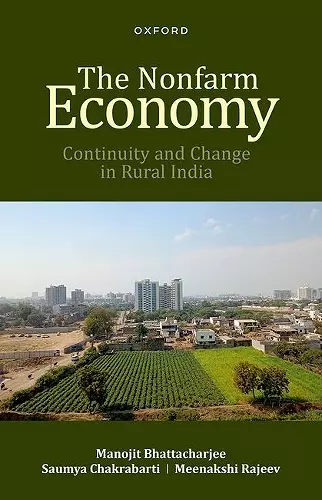
The dominant discourse views the Indian economy's transformation over several decades as a progression towards a grand, unified, and dynamic market economy. Critiquing this discourse, The Nonfarm Economy illustrates the prevalence and intensification of 'structural dualism'. Using both theoretical and empirical perspectives, Bhattacharjee, Chakrabarti, and Rajeev analyse the origins of this persistence and the deepening of a dualistic developmental pattern. By studying the Indian rural economy and parts of the rural Global South, they demonstrate how the contemporary capital-centric growth process itself has induced the intensification of dualism, alongside factors such as population growth and land fragmentation. Only a limited segment of the impoverished population can integrate with the expanding circuits of capital using their skills, resources, and networks; a large mass of people is thus pushed towards dispossession and exclusion. The book further examines the effects of the COVID-19 pandemic on this development pattern, demonstrating how it has intensified the phenomenon of structural dualism. Contrary to the current prescriptions fixated on formal sector growth and policies extending government support, the authors posit a labour-focused (cluster-based) development model and offer constructive policy recommendations for achieving inclusive growth.
This extraordinary book illuminates in a coherent manner, imaginatively combining data with formal modelling, that dark corner of development economics called the 'nonfarm' informal economy. Although India is the primary focus, many developing countries and regions across the globe find their place in the comparative analysis. It is an extremely valuable addition to the development literature and should be on the essential reading list of students, researchers and practitioners concerned with development studies and problems. * Amit Bhaduri, Retired Professor, CESP, Jawaharlal Nehru University *
This groundbreaking book is a must-read for anyone concerned about the persistence and even the rise of the informal sector. Based on an extended structuralist model, the authors use in-depth case studies of selected Indian regions, econometric analysis, and international comparisons to provide empirical evidence of the counterintuitive effect of formal sector growth: the squeezing out of the agricultural sector and the consequent expansion of petty, non-agricultural, informal activities in rural areas. It is up to date with an analysis of the impact of the COVID pandemic and offers thoughtful policy recommendations. * Christoph Scherrer, Kassel Institute for Sustainability *
Mainstream development literature maintains that economic dualism will gradually disappear in the poorer countries as, under the guidance of free market forces, they converge to a unified capitalistic modern economy with full participation of the labour force. This has not happened. Not only has the old industry-agriculture dualism persisted, but even within non-agriculture, a significant type of neo-dualism has emerged, comprising a modernizing nonfarm sector and petty informal activities. As a result, poverty, unemployment, economic exclusion, and insecurity refuse to vanish despite impressive overall aggregative growth. Using an elegant analytical framework well supported by Indian data, the authors have succeeded in providing very important insights into this disturbing puzzle of neo-dualism. This is a truly impressive intellectual achievement. * Soumyen Sikdar, Retired Professor, Indian Institute of Management Calcutta *
The authors of The Nonfarm Economy combine considerable analytical expertise, deep knowledge of data, keen understanding of policymaking, and clear, effective writing to explore a key question in India's ongoing economic transformation: How does capitalist growth impact rural economic structures? * Tirthankar Roy, Professor of Economic History, London School of Economics *
ISBN: 9780198972020
Dimensions: 20mm x 140mm x 216mm
Weight: 445g
276 pages