Conflict between Equals
Tort Law beyond Wrong, Harm, and Cost
Format:Hardback
Publisher:Oxford University Press
Published:30th Apr '26
Should be back in stock very soon
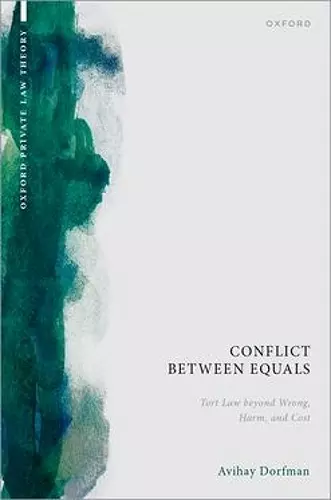
Conflict between Equals argues that tort law has to be understood and ultimately vindicated as the actualization of two theories: the conflict and the equality theory of tort law. It is not harm, wrongdoing, or social cost that gives us reason to have tort law in the first place. Instead, it is human conflict-specifically, conflict between our fundamental interests-that serves as the moral function of tort law. How we respond to such conflicts determines which harms, wrongs, or costs should, if at all, be addressed by tort law. The conflict theory elaborates on the nature and normative significance of three types of conflict: inherently valuable, tolerably valuable, and valueless. The theory emphasizes the importance of preventing valueless conflict, containing tolerably valuable conflict, and constructing the conditions necessary for inherently valuable conflict to arise. Moreover, the human conflict to which tort law responds reflects a commitment to treating the parties to a conflict as equals. The equality theory is grounded in the egalitarian ideal of relating as equals, thus tort law must determine terms of interaction that take seriously differences in the interests and conditions of the interacting parties. By doing so, tort law secures the ability of the parties in a conflict to relate as substantive, rather than merely formal, equals.
Avihay Dorfman has written a masterpiece. Conflict between Equals fundamentally reframes the field of tort theory, moving sophisticatedly beyond the traditional concepts of "wrongs", "recourse" and "cost-internalization". By insisting that the law must construct, not merely correct, human interaction, Dorfman vindicates tort law as a constitutive institution of a liberal society. With philosophical rigor and doctrinal sensitivity, he offers a profound vision of how private persons can relate as substantive equals. This transformative work that will shape the conversation for decades to come, is essential reading for legal scholars, philosophers, students, and practitioners. * Ariel Porat, Professor of Law and President of Tel Aviv University *
In a series of sophisticated articles published over the last fifteen years, Avihay Dorfman has developed the view that tort law expresses a substantive and liberal conception of relational equality. In his sustained elaboration of this view in his new book, Conflict of Equals, Dorfman ambitiously attempts to disclose how (as he puts it) "tort law constructs the normative universe we inhabit in our daily lives." Both for those who are sympathetic to his approach and for those who are not, this engaging and expansive book will consolidate Dorfman's position in the forefront of contemporary tort theory. * Ernest J. Weinrib, University Professor Emeritus, University of Toronto *
The field of tort law has been waiting for this book. Conflict Between Equals manages to take central insights from decades of tort law scholarship and synthesize them into a single account that also introduces a novel overarching understanding of why tort law continues to matter. By placing conflict at the heart of tort theory, Dorfman reveals the positive role that tort law plays in structuring human interactions precisely because the field is forced to make substantive choices between competing priorities. Dorfman also gives due regard to tort law's commitment to relational equality that is necessary for any ongoing conflict resolution mechanism to maintain legitimacy within a private law system. In short, all of tort law is in this book, and all who care about the field should read it. * Douglas A. Kysar, Yale University *
Conflict between Equals is at once lucid and accessible, and deep and provocative. It steps back from debates about costs, wrongs, and harms to ask why we have tort law at all. Dorfman's answer is twofold. First, we have tort law to address conflicts among persons and their interests. Second, tort's private law structure imposes a form on tort law's function. That form expresses a powerful idea of relational equality. Dorfman brings these two theories into dialog with one another, leading its readers to be continuously aware that tort law's doctrine, structure, and function are bursting with latent value commitments. The result is a book that is alive with insight and thought and which awakens thought. It should stir us all to rethink matters previously regarded as settled and to change the way we think about the subject. * Gregory Keating, University of Southern California *
ISBN: 9780198979876
Dimensions: 240mm x 160mm x 30mm
Weight: 795g
432 pages