Southeast Asia's Development
Towards Liberal Individualism and Inclusive Governance
Format:Hardback
Publisher:Oxford University Press
Published:28th Feb '26
Currently unavailable, and unfortunately no date known when it will be back
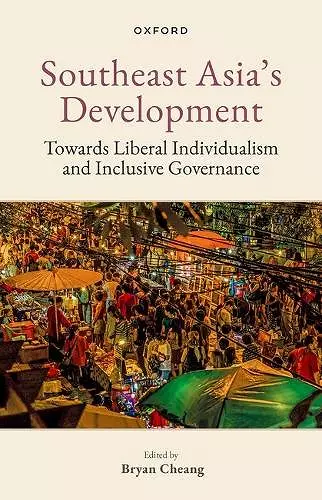
This volume challenges dominant narratives about Southeast Asia's development by bridging a long-standing intellectual divide. On the one hand, liberal thinkers rarely engage with the developmental histories and practices of the non-Western world. On the other, Asian scholars and heterodox critics often treat economic liberalism as a "neoliberal" project imported in unsavoury circumstances. Bringing these worlds into conversation, Southeast Asia's Development advances a distinct view of liberal development in the tradition of Adam Smith and F.A. Hayek--rooted in individualism, social pluralism, and negative rights--to expose the failures of the region's entrenched model of elite-driven political capitalism. While globalization and partial liberalization since the 1980s have raised living standards, Southeast Asian states continue to uphold regimes that hollow out personal agency, treating citizens as instruments of national performance, economic units to be optimized, or bodies to be disciplined, rather than as persons with ends of their own. This volume advances a new normative ideal: development as freedom to discover, treating development as the preservation of individual spaces that enable people to pursue their own conceptions of good within the rules they help shape. It is thus a call to reimagine development not as a collective end-goal but an open-ended process of human discovery and institutional experimentation.
This magisterial volume is a brilliant antidote to the casual triumphalism of most analysis of Southeast Asia. The authors document the violations of political and economic rights in the region with authoritarian governments catering to elites. It suggests the lack of freedom has not only hindered material progress but denied individuals the ability to define for themselves what is really progress. * William Easterly, Professor of Economics, New York University (NYU), and Co-Director, NYU Development Research Institute *
Any novelty depends on an idea in a human head. The master idea for Southeast Asia, as it was for Britain in 1800, Japan in 1900, and India now, is not the State, but Liberty. Bryan Cheang shows so--elegantly, scientifically, crushingly. * Deirdre McCloskey, Distinguished Scholar, Isaiah Berlin Chair in Liberal Thought, Cato Institute *
A brilliant collection that explores the role of Smithian liberal political economy in the development history of Southeast Asia. Bryan Cheang is not only one of the best scholars in this field, he also does an outstanding job in this volume of creating space for this important conversation. In the process, we learnt what has hindered development, namely, state interventionism and the entangled relationship between economics and politics, and what can be done to unleash the extraordinary creativity and resourcefulness of ordinary people through a transition to liberal principles of political economy and justice. All students of development and political economy will want to add this title to their must-read list. * Peter Boettke, Distinguished University Professor of Economics, George Mason University *
This collection provides a unique perspective on Asian development, seeing it through the lens of liberal political economy. Its contributions are written in an engaging and accessible style, ensuring that it will be widely read. * Sir Tim Besley, School Professor of Economics and Political Science and W. Arthur Lewis Professor of Development Economics, London School of Economics *
ISBN: 9780198984177
Dimensions: 28mm x 140mm x 216mm
Weight: 626g
430 pages