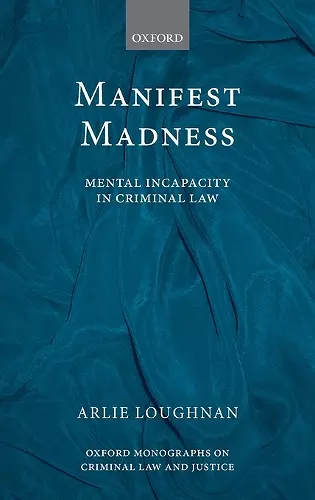
Manifest Madness
Mental Incapacity in the Criminal Law
Format:Hardback
Publisher:Oxford University Press
Published:19th Apr '12
Currently unavailable, and unfortunately no date known when it will be back
Part of the OAPEN-UK project
Bringing together previously disparate discussions on criminal responsibility from law, psychology, and philosophy, this book provides a close study of mental incapacity defences, tracing their development through historical cases to the modern era.This is an open access title available under the terms of a CC BY-NC-ND 3.0 International licence. It is free to read at Oxford Scholarship Online and offered as a free PDF download from OUP and selected open access locations. Whether it is a question of the age below which a child cannot be held liable for their actions, or the attribution of responsibility to defendants with mental illnesses, mental incapacity is a central concern for legal actors, policy makers, and legislators when it comes to crime and justice. Understanding mental incapacity in criminal law is notoriously difficult; it involves tracing overlapping and interlocking legal doctrines, current and past practices of evidence and proof, and also medical and social understandings of mental illness and incapacity. With its focus on the complex interaction of legal doctrines and practices relating to mental incapacity and knowledge - both expert and non-expert - of it, this book offers a fresh perspective on this topic. Bringing together previously disparate discussions on mental incapacity from law, psychology, and philosophy, this book provides a close study of this terrain of criminal law, analysing the development of mental incapacity doctrines through historical cases to the modern era. It maps the shifting boundaries around abnormality as constructed in law, arguing that the mental incapacity terrain has a distinct character - 'manifest madness'.
In combining evidentiary, procedural, and historical approaches to the topic, Dr. Loughnan provides an original conception of the connections between mental incapacity doctrines... Manfest Madness is a well-written and thoughtful book that ... displays a level of scholarship of the highest merit. Loughnan is to be congratulated for her insightful work on a complex topic. * Bernadette McSherry, U.B.C. Law Review *
Manifest Madness offers a theoretically sophisticated, historically informed account of seven aspects of English criminal law which it identifies as making up the 'terrain' of mental incapacity. * Tony Ward, Modern Law Review *
Manifest Madness offers readers a remarkably comprehensive and insightful analysis of the interaction of defenses based on mental derangement with the evolution of common law principles centering on criminal culpability. Surveying a wealth of materials - contemporary legal texts, Parliamentary legislation, and criminal cases from the Old Bailey; social histories of popular attitudes on madness; tracts of medical psychology and increasingly assertive professional opinion - Arlie Loughnan has produced a work that will become the standard text for historians of law, medicine and the criminal courts. Particularly noteworthy is her explanation of the 'formalization' of legal procedures regarding the prosecution of trials that tuned on the question of mental distraction. Lucidly written and cogently argued, her scholarship is a pleasure to read. * Joel Peter Eigen, Charles A. Dana Professor of Sociology, Franklin & Marshall College *
Manifest Madness is a book of great merit. It is a thoroughly researched and engaging piece of work that successfully marries deep, theoretical and normative issues with detailed consideration of legal doctrine and procedure, an achievement that few scholars attempt let alone accomplish. Loughnan is to be congratulated for producing a book that strengthens this exciting field. * Chloë Kennedy, University of Edinburgh, Edinburgh Law Review *
Loughnan's Manifest Madness is an original and thoughtful analysis of ways in which the law has grappled with the abnormal. It challenges the reader to reconceptualise a range of the defences and mitigating factors that are part and parcel of the contemporary legal landscape. Its use of social and historical contextualisation develops previous analyses and is lively. The work is thoroughly researched and interestingly argued... Manifest Madness should be welcomed as a fresh and conceptually challenging contribution to criminal law theory. * Ian Freckelton, Psychiatry, Psychology and Law *
An important monograph, which contains a novel and thought provoking analysis of the role of mental incapacity in the criminal law. Underpinning her analysis with historical research, the author gives a unique insight into the nature and character of mental incapacity doctrines which takes the reader well beyond insanity and related defences to include infancy, intoxication, infanticide and unfitness to plead. The result is a book which will not only challenge and enlighten scholarly debate but also will help to stimulate and inform the current reform agenda. * Ronnie D. Mackay, Professor of Criminal Policy and Mental Health, De Montfort University *
ISBN: 9780199698592
Dimensions: 240mm x 161mm x 25mm
Weight: 626g
308 pages