Government against Itself
How Public Employee Unions Weaken America's Government and Economy
Format:Hardback
Publisher:Oxford University Press Inc
Published:29th Jan '15
Should be back in stock very soon
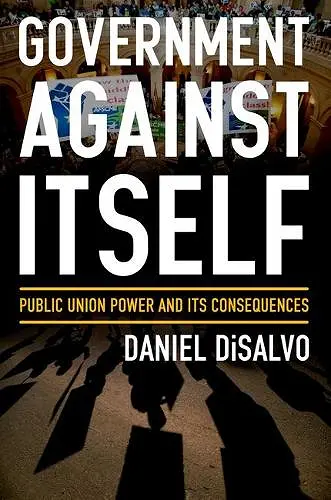
As workers in the private sector struggle with stagnant wages, disappearing benefits, and retirement ages that are moving further and further out onto the horizon, unionized gym teachers and lifeguards employed by the public sector retire in their fifties with over $100,000 a year in pension and healthcare benefits. Some even supplement this generous income by taking other jobs in their "retirement." Attempts to rein in the unions, as in Wisconsin and New Jersey, have met with massive resistance. Yet as Daniel DiSalvo argues in Government against Itself, public sector unions threaten the integrity of our very democracy. DiSalvo, a third generation union member, recognizes the difference that collective bargaining made in the lives of his immigrant grandfather, a steelworker in Pittsburgh, and his father, a carpenter. He is not opposed to unions on ideological grounds. Rather, he opposes the form they have taken in the public sector, where they often face no real opposition in negotiations. Moreover, the public sector can't go out of business no matter how much union members manage to squeeze out of it. Union members have no incentive to ever settle for less, and this has a profound impact on the health of our society, as the costs get passed along to the taxpayer. States and municipalities break under the weight of their pension obligations, and the chasm between well-compensated public sector employees and their beleaguered private sector counterparts widens. Where private sector unions can provide a necessary counterweight to the power of capital, public employee unions are basically bargaining against themselves; it's no wonder they almost always win. The left is largely in thrall to the unions, both ideologically and financially; the right would simply take a hatchet to the state itself, eliminating important and valuable government services. Neither side offers a realistic vision of well-run, efficient government that serves the public. Moving beyond stale and unproductive partisan divisions, DiSalvo argues that we can build a better, more responsive government that is accountable to taxpayers. But we cannot do it until we challenge the dominance of public sector unions in government. This carefully reasoned analysis of the power of public sector unions is sure to be controversial, and will be an important contribution to the debates about public vs. private unions, increasing inequality, and the role of government in American life.
Although many arguments will be familiar to some, DiSalvo produces fresh, engaging, provocative arguments that scholars, policy makers, and the public should consider and debate. * R. L. Welch, West Texas A&M University, CHOICE *
Readers of any political persuasion should be sobered by his observation that democratic government's inevitable fate seems to be 'spending more, getting less.' * Publishers Weekly *
A sober analysis, both scholarly and political, of public sector unions. DiSalvo shows both sides, argues cogently, and concludes reasonably * against them. This is political science at its best.Harvey Mansfield, Professor of Government, Harvard University; Senior Fellow, Hoover Institution *
Daniel DiSalvo has laid bare the harsh political realities facing mayors across the country who want to improve the quality of life in their cities. In the annual battles over cutting services, raising taxes or controlling costs to balance the budget, public employee unions usually have the upper hand. In many jurisdictions, costs are skyrocketing, taxes are up and services are deteriorating, yet fiscal reform seems impossible. This book explains how and why the narrow interests of unions in improving pay and benefits frequently overwhelm the broader interests of the people in improving services. * Chuck Reed, Mayor of San Jose *
ISBN: 9780199990740
Dimensions: 163mm x 236mm x 31mm
Weight: 540g
304 pages