Disparate Remedies
Making Medicines in Modern India
Format:Paperback
Publisher:McGill-Queen's University Press
Published:15th Jul '23
Currently unavailable, and unfortunately no date known when it will be back
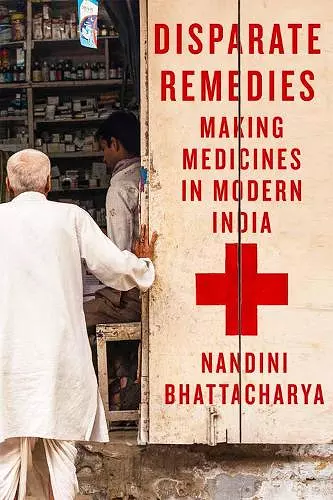
A cultural history of medicines in colonial and postcolonial India.
At present India is a leading producer, distributer, and consumer of generic medicines. Tracing this development, Disparate Remedies explores the integrated histories of the medical market and industrially manufactured medicines in colonial and postcolonial India, engaging with the cultures of both consumption and production.
At present India is a leading producer, distributor, and consumer of generic medicines globally. Disparate Remedies traces the genealogy of this development and examines the public cultures of medicine in the country between 1870 and 1960.
The book begins by discussing the expansion of medical consumerism in late nineteenth-century India when British-owned firms extended their sales into remote towns. As a result, laboratory-produced drugs competed with traditional remedies through side-by-side production of Western and Indian drugs by pharmaceutical companies. The emergent middle classes, the creation of a public sphere, and nationalist politics transformed the medical culture of modern India and generated conflict between Western and Indigenous medical systems and their practitioners. Nandini Bhattacharya demonstrates that these disparate therapies were sustained through the tropes of purity or adulteration, potency or lack of it, and epistemic heritage, even when their material configuration often differed little.
Uniquely engaging with the cultures of both consumption and production in the country, Disparate Remedies follows the evolution of medicine in colonial India as it confronted Indian modernity and changing public attitudes surrounding health and drugs.
“Disparate Remedies demonstrates the eclecticism of every aspect of the drug trade, illustrating how a lack of legislation and regulation largely resulted in a ‘free-for-all’ in the making, supply, and sale of remedies with the consequent ubiquity of counterfeiting, adulteration, and supply of substandard medicines. The great contribution of this book is that it provides a longer historical perspective and narrative than many previous works, suggesting that the rapid rise of the pharmaceutical industry in India can only be understood by knowing its historical context.” Stuart Anderson, London School of Hygiene and Tropical Medicine
“Through meticulous research and an interdisciplinary approach, Bhattacharya offers valuable insights into colonial and postcolonial India’s intersections of history, medicine, trade and industry. Moreover, this work has implications beyond academia. Its findings can inform contemporary discussions and policy making on health care provision and pharmaceutical regulation in present-day India.” British Journal for the History of Science
ISBN: 9780228017530
Dimensions: unknown
Weight: unknown
272 pages