Queer Beauty
Sexuality and Aesthetics from Winckelmann to Freud and Beyond
Format:Hardback
Publisher:Columbia University Press
Published:17th Sep '10
Currently unavailable, and unfortunately no date known when it will be back
Whitney Davis is a wonderful art historian with a supple mind, a feel for the broader humanities, and deep interests in philosophy, aesthetics, and psychoanalysis. He is also a scholar with a profound knowledge of the history of queer theory and gay life. These qualities and interests make him the ideal--perhaps uniquely ideal--person to write this book. -- Daniel Herwitz, University of Michigan, author of The Star as Icon: Celebrity in the Age of Mass Consumption In Queer Beauty, Whitney Davis inspires us to view Kant--and all aesthetics--differently. Davis critiques 'disinterestedness' and other modern concepts to show that they sustain sexuality and aesthetics in recursive relationships. Who else but Davis could give a philosophical account of the genealogy of sexuality and aesthetics that, politically, allows homoerotically inclined viewers to '(re)discover their participation in the dynamical constitution of ideals of beauty' and, ethically, reveals that a task of art is the idealization of erotic sociability 'that might eventually ensure that humanity will flourish rather than decline?' Who else could invoke the 'sniper' of the 'Monk's Head' orchid as a metaphor to give queer beauty and beauty queered their philosophical due and forever change our thinking about sexuality and aesthetics? -- Michael Kelly, University of North Carolina
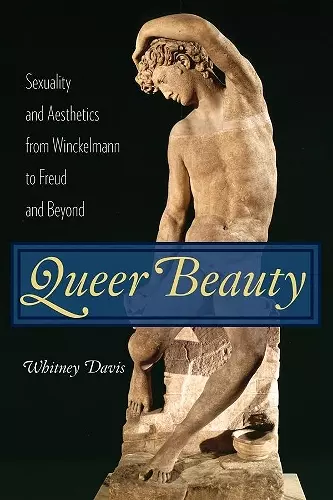
The pioneering work of Johann Winckelmann (1717-1768) identified a homoerotic appreciation of male beauty in classical Greek sculpture, a fascination that had endured in Western art since the Greeks. Yet after Winckelmann, the value (even the possibility) of art's queer beauty was often denied. Several theorists, notably the philosopher Immanuel Kant, broke sexual attraction and aesthetic appreciation into separate or dueling domains. In turn, sexual desire and aesthetic pleasure had to be profoundly rethought by later writers. Whitney Davis follows how such innovative thinkers as John Addington Symonds, Michel Foucault, and Richard Wollheim rejoined these two domains, reclaiming earlier insights about the mutual implication of sexuality and aesthetics. Addressing texts by Arthur Schopenhauer, Charles Darwin, Oscar Wilde, Vernon Lee, and Sigmund Freud, among many others, Davis criticizes modern approaches, such as Kantian idealism, Darwinism, psychoanalysis, and analytic aesthetics, for either reducing aesthetics to a question of sexuality or for removing sexuality from the aesthetic field altogether. Despite these schematic reductions, sexuality always returns to aesthetics, and aesthetic considerations always recur in sexuality. Davis particularly emphasizes the way in which philosophies of art since the late eighteenth century have responded to nonstandard sexuality, especially homoeroticism, and how theories of nonstandard sexuality have drawn on aesthetics in significant ways. Many imaginative and penetrating critics have wrestled productively, though often inconclusively and "against themselves," with the aesthetic making of sexual life and new forms of art made from reconstituted sexualities. Through a critique that confronts history, philosophy, science, psychology, and dominant theories of art and sexuality, Davis challenges privileged types of sexual and aesthetic creation imagined in modern culture-and assumed today.
... A difficult but thrilling book to read. -- Kevin Ohi, Boston College Victorian Studies
ISBN: 9780231146906
Dimensions: unknown
Weight: unknown
368 pages