Nietzsche
Anti-Philosophy 1
Alain Badiou author Bruno Bosteels translator Susan Spitzer translator
Format:Hardback
Publisher:Columbia University Press
Published:2nd Jun '26
Should be back in stock very soon
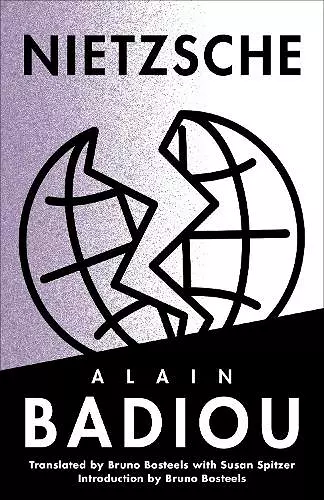
For Alain Badiou, Friedrich Nietzsche is the “prince” of anti-philosophy. French leftist thinkers celebrated Nietzsche in the second half of the twentieth century, but when a backlash emerged in the 1990s, Badiou refused to join the attack. Instead, he devoted his 1992–1993 seminar to an astonishingly original reading of Nietzsche—to whom he had previously shown indifference or scorn—in which he appears almost enamored with the author of The Anti-Christ and Ecce Homo.
This book presents Badiou’s seminar on Nietzsche’s late works, which for the first time addresses what would become one of his central concepts: anti-philosophy and its adversarial yet intimate relationship with philosophy. For Badiou, Nietzsche is the key modern anti-philosopher, his antagonist—and occasional ally—in the battle to redefine the work of philosophy. Badiou takes for granted Nietzsche’s declaration that “God is dead,” yet rejects his assertion that philosophy too is past its expiration date. Badiou engages a century-long tradition of grappling with Nietzsche’s paradoxes, considering thinkers such as Heidegger, Deleuze, and Derrida. Examining Nietzsche’s impassioned writings on Wagner, he reflects on the nature of art and aesthetics. Provocative and profound, this seminar shows Badiou’s ongoing project of reasserting the value of philosophy from a new angle.
In this seminar, Badiou sets out to address fundamental questions that concern any engagement with Nietzsche and his legacy: In what sense is he a philosopher? In what sense might ‘we’ or our century be called ‘Nietzschean’? And how might engagement with Nietzsche and his most incisive readers clarify the wider relation between philosophy and art? These questions are filtered through the literally decisive question of value. This puts Badiou and Nietzsche on a fascinating collision course, as regards the value of truth, of affirmation, and of philosophy itself. -- Peter Hallward, author of Badiou: A Subject to Truth
This book supplies a completely novel interpretation of the importance of Nietzsche’s philosophy for the contemporary world. In Badiou's examination of his late writings, Nietzsche ceases to be just a worthy antagonist for Badiou’s thought and becomes instead a valuable ally in his philosophical project. What emerges here is a breathtaking exploration of Nietzsche that departs from all the received wisdom. -- Todd McGowan, author of Pure Excess: Capitalism and the Commodity
In this remarkable seminar, the “Prince of philosophy” turns his attention to the “Prince of anti-philosophy.” Badiou’s reading of the final Nietzsche is at once rigorous and enchanting: he traces how Nietzsche configures event, act, and art—only to push this configuration to the point of detonation. That detonation, in turn, illuminates another configuration: that of Badiou’s own philosophy. Within it, the anti-philosophers—Saint Paul, Wittgenstein, Lacan, and of course Nietzsche—occupy a privileged place: not as adversaries, but as sites where the relation between philosophy and its conditions—politics, science, love, and art—appears in a strikingly illuminating way. -- Alenka Zupančič, author of The Shortest Shadow: Nietzsche's Philosophy of the Two
ISBN: 9780231181303
Dimensions: unknown
Weight: unknown
392 pages