Ambivalent Recognition
The Harmful Social Consequences of an Ethical Good
Kristina Lepold author Ciaran Cronin translator
Format:Hardback
Publisher:Columbia University Press
Published:12th May '26
£94.00
Supplier delay - available to order, but may take longer than usual.
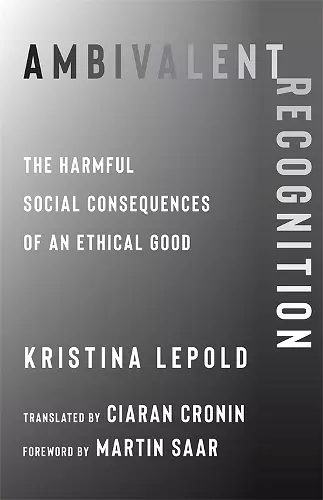
Recognition has become one of the key concepts of contemporary critical theory, heralded by thinkers such as Axel Honneth and Charles Taylor. It is widely claimed that a person must be recognized by others in order to realize their own identity and that the lack of recognition constitutes a form of oppression or injustice. Is recognition always a good thing?
In this ambitious and compelling book, Kristina Lepold challenges the common assumption that recognition is positive, emphasizing its ambivalent role in social life. She offers a systematic account of the complex nature of recognition, showing how it can implicate us in oppressive or otherwise problematic arrangements. Lepold engages with different approaches for thinking about recognition—including Axel Honneth’s influential theory, as well as arguments made by Louis Althusser, Pierre Bourdieu, and Judith Butler—which she reconstructs in a nuanced and accessible fashion.
By one of the most original voices in the new generation of critical theorists, Ambivalent Recognition is a must-read for anyone interested in not only one of critical theory’s key concepts but also the larger question of why unjust social arrangements often prove so stubborn and difficult to change.
Ambivalent Recognition is an impressive first book by Kristina Lepold, one of the most exciting voices of a new generation of critical theorists. She argues, convincingly, that we should see recognition—usually thought of as something positive—as ambivalent, for it can make us complicit in problematic social arrangements. -- Sally Haslanger, author of Resisting Reality: Social Construction and Social Critique
There is nothing more productive for a theory than to examine it so incisively that all its internal problems and difficulties come to the surface. Kristina Lepold confronts recognition with its critics, who emphasize that a positive attribution of recognition to a person or group comes at the price of inclusion in an existing order of domination. A masterful study of the negative consequence of perpetuating social oppression. -- Axel Honneth, coauthor of Redistribution or Recognition? A Political–Philosophical Exchange
According to the French tradition, recognition is always subjecting, while authors such as Charles Taylor and Axel Honneth have emphasized its ethical potential. Kristina Lepold’s fascinating book rejects this seemingly binary choice. The book is a must-read for everyone interested in contemporary critical theory. -- Rahel Jaeggi, author of Critique of Forms of Life and Alienation
Feminists and multicultural theorists often argue that oppressed people have to misrepresent their interests—and their selves—in order to be politically legible. Lepold’s important book sheds new light on what is at stake in claims that the marginalized are misrecognized. -- Serene Khader, author of Faux Feminism: Why We Fall for White Feminism and How We Can Stop
Kristina Lepold’s Ambivalent Recognition makes an original and important contribution to our understanding of how our recognition of ourselves and others is often caught up in, and contributes to, a web of oppressive practices. -- Charlotte Witt, author of Social Goodness: The Ontology of Social Norms
ISBN: 9780231217293
Dimensions: unknown
Weight: unknown
248 pages