Napoleon's Closet
The Emperor, the Priest, and the Men Who Invented Modern Fashion
Format:Paperback
Publisher:Columbia University Press
Publishing:18th Aug '26
£22.00
This title is due to be published on 18th August, and will be despatched as soon as possible.
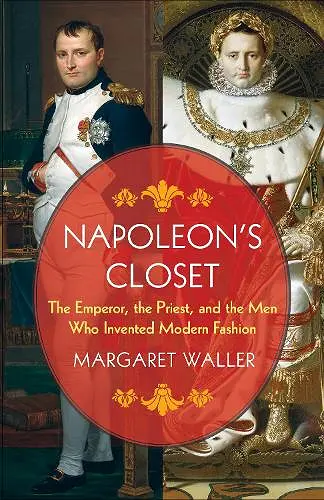
Why do the most powerful men in the West wear sober, understated attire? Until the “Great Masculine Renunciation” in the eighteenth century, luxurious and often flamboyant clothing signaled social superiority for men as well as women.
Margaret Waller’s fresh account of this historic recalibration of gender and class centers on an unlikely pair: Napoleon Bonaparte, the Corsican upstart who crowned himself emperor of France, and Pierre Antoine Le Boux La Mésangère, the defrocked priest who became Europe’s premier fashion editor. Looking at knee breeches, schoolboy and officer uniforms, priests’ robes, and imperial regalia, this book shows how misogyny and homophobia helped make Bonaparte, La Mésangère, and their peers men.
Napoleon’s Closet shows when male fashion editors first associated women with fashion and urged men to renounce “feminine” frivolity in their dress. It connects French revolutionaries’ masculinist construction of citizenship to the Church’s long-standing requirement that its rank and file wear plain, modest clothing. It demonstrates that although Napoleon’s reinstitution of sumptuous uniforms for men might seem the exception, he reserved for himself the modern male privilege of dressing down.
A lively and unorthodox exploration of the paradoxical history of male clothing, this book unveils the origins of modern ideas about normative masculinity, queerness, and “the closet.”
Margaret Waller’s Napoleon’s Closet juxtaposes the clothing history of the emperor of the French with that of an obscure priest turned fashion editor who was known as the ‘emperor of fashion.’ This is an original and brilliant exploration of the Great Masculine Renunciation, aka why modern men dress so differently than women. -- Valerie Steele, director and chief curator, Museum at the Fashion Institute of Technology, and founder and editor in chief of Fashion Theory: The Journal of Dress, Body & Culture
Napoleon’s Closet demonstrates not only that fashion is political but also that it actually shapes politics. Waller has created a new genre, blending history, biography, gender, and fashion studies—all presented in elegant, lively prose. This book opens a new portal into French history, proving that seismic, global events—such as revolutions—are often generated and sustained by sartorial changes and details too often overlooked. This is radical, feminist scholarship—and a fabulous read. -- Rhonda Garelick, John Cranford Adams Distinguished Professor of Literature, Hofstra University, and author of Mademoiselle: Coco Chanel and the Pulse of History
Waller takes us into Napoleon’s clothing wardrobe to find it more complicated than we assumed—and much more fascinating. In the wardrobe hide renunciation and ostentation, along with a forgotten but crucial character: La Mésangère, defrocked Catholic priest and lord over the world’s first modern women’s fashion magazine. Until the brilliant queer insights of this book into masculine sartorial concatenations and obsessions, we just repressed whole zones of clothing history. With sympathy and wit, Waller rewrites the birth of modern fashion. Read and laugh along with her. -- Anne Higonnet, Barbara Novak Professor of Art History, Barnard College, Columbia University, and author of Liberty, Equality, Fashion: The Women Who Styled the French Revolution
An audacious, insightful book. With wit, theoretical clarity, and exacting scholarship, Margaret Waller makes masculinity newly strange—revealing how power learns to dress, conceal itself, and survive. Napoleon’s Closet permanently alters how we read modern male authority. -- Susan L. Siegfried, author of The New Taste: Fashion and Art in the 1820s and 1830s
ISBN: 9780231223331
Dimensions: unknown
Weight: unknown
360 pages