Beautiful Particulars
How AI's Attention to the Smallest of Differences Is Reshaping Our Biggest Ideas
Format:Hardback
Publisher:MIT Press Ltd
Publishing:3rd Nov '26
£26.00
This title is due to be published on 3rd November, and will be despatched as soon as possible.
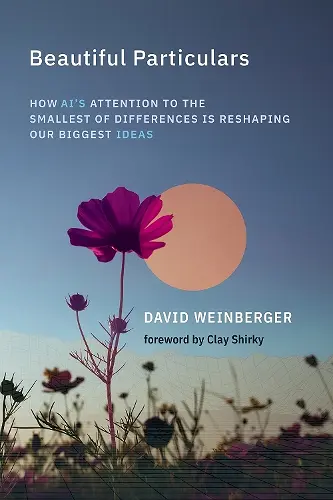
A fresh and eye-opening new explanation of AI and how its focus on specifics is changing our ideas about ourselves and our world. From a Harvard researcher, philosopher, entrepreneur, former comedy writer, and bestselling author. Amid the clamor about AI, Beautiful Particulars poses a unique question: Not how our use of AI will change what we do, but how the idea of AI may already be subtly, yet fundamentally, reshaping how we think about ourselves and our world. In clear, engaging, and even humorous prose, David Weinberger offers a new perspective on how machine learning works and how it may already be changing our basic and deepest ideas. Through lively examples, he shows that AI s success with all its risks and dangers is taking us past our millennia of reliance on laws and principles by revealing what morality, free will, creativity, causality, knowledge, and even reality itself look like now that we re able to let the particulars speak their tiny truths. The author poses questions not usually asked: What does a coin look like to AI? When AI gives you evidence that the Earth is round, why are its own reasons for saying that so different? Why does an AI image generator create a 'selfie' of ancient Aztec warriors with broad smiles that it 'believes' are historically unlikely? If AI becomes conscious but bodiless, could it still make good moral decisions? Why is the world so much better at being causal than AI could ever 'understand'? How does AI show us that genuine creativity is not about a 'spark' but about moments that feel right? And how can you take the temperature of a joke? Beautiful Particulars offers a new and hopeful perspective on how machine learning works, and how that s already changing how we understand what it means to be human in the age of AI.
“When David Weinberger, one of our best decoders of digital transformation, looks at generative AI, you need to pay attention. His explanation of how large language models can expand human perception is provocative and illuminating. Gemini, Claude, and ChatGPT will be jealous.”
—Steven Levy, author of Hackers, Crypto, and Facebook: The Insider Story
“David Weinberger is a wonderfully engaging writer. If we reflect on how AI operates, he argues, we can gain insights into some of our most intractable philosophical problems. He makes a compelling case. And he does so with tremendous wisdom and wit.”
—David Edmonds, author of Death in a Shallow Pond
“While most people write about the dangers of slop, David Weinberger writes about the value of the ‘particular,’ both explaining and illustrating it in this marvelous, eye-opening book.”
—Esther Dyson, Founder, Health Initiative Coordinating Council; author of In Defense of Limits (forthcoming)
“With wit and precision, Weinberger masterfully explores how AI illuminates the relationship between language and reality. He shows how by preserving the particular over the general, AI can change how we understand fairness, causality—and ourselves.”
—Jonathan Zittrain, Professor of Law, Computer Science, and Public Policy, Harvard University
“A marvelous, erudite contemplation of what machine learning means for humanity today. To Weinberger, these new machines preserve patterns of difference that older computer systems ignored—and this changes our sense of fairness, data, and what generalizations are. A delight to read.”
—Bruce Schneier, coauthor of Rewiring Democracy: How AI Will Transform Our Politics, Government, and Citizenship
"Beautiful Particulars is a playful book with a poignant message: AI works through particulars, not generalizations. Getting your head wrapped around this notion will change how you see AI. And luckily, Weinberger’s pithy book weaves together stories, snark, and philosophy to offer a road map."
—danah boyd, Geri Gay Professor of Communication, Cornell University; author of Data Are Made, Not Found
ISBN: 9780262054867
Dimensions: unknown
Weight: unknown
184 pages