Political Institutions and Party System Change in Chile
Competition, Realignment, and Breakdown
Format:Hardback
Publisher:University of Notre Dame Press
Publishing:15th Aug '26
£48.00
This title is due to be published on 15th August, and will be despatched as soon as possible.
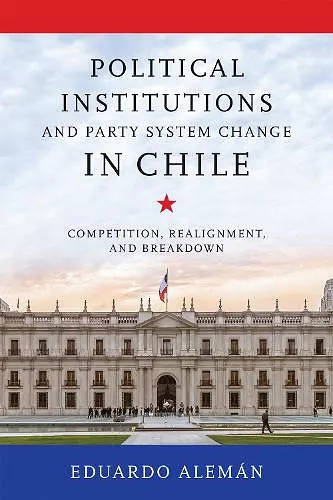
Eduardo Alemán provides a definitive institutional account of how Chile's party system was remade—and ultimately undone—after authoritarian rule.
In Political Institutions and Party System Change in Chile, Eduardo Alemán offers the most comprehensive analysis to date of Chile's party system, tracing its evolution from the 1930s through the early 2020s. He begins with an analysis of how parties interacted before 1973, establishing a historical baseline both for understanding how the post-authoritarian configuration diverged from its predecessors and for tracing how patterns of competition evolved. Alemán then examines how a major realignment following the end of military rule (1973–1990) produced a distinctive, remarkably stable post-authoritarian party system and investigates why that system unraveled nearly three decades later.
Drawing from extensive original data on presidential cabinets, congressional voting, bill initiation, and elections, Alemán explores interparty competition across three core arenas: governmental, electoral, and legislative. He documents the importance of institutional arrangements inherited from the military regime by the new government and dissects how the 2015 electoral reform that eliminated the binomial system contributed to its demise.
Ultimately, Alemán challenges sociological and continuity-based interpretations of Chilean politics and presents a conceptual framework for analyzing stability and change in party systems more broadly.
"For more than two dozen years, Chile's post-authoritarian party system was considered an exemplar for Latin America, with two relatively stable partisan coalitions constituting a key pillar of the widely praised Chilean political and economic model. Eduardo Alemán's outstanding book expertly analyzes the ancestry, birth, life, and death of Chile's post-authoritarian party system, underscoring the powerful contribution of a pivotal 2015 electoral reform to the system's demise. Alemán's book is a must-read for everyone with an interest in Chilean politics and government as well as for scholars of political institutions more generally. The former will benefit from the detailed and insightful examination of the Chilean party system and functioning of the country's political institutions over the past hundred years, while the latter will greatly appreciate the sophisticated linkage between electoral system reform and party system change revealed by the book's pathbreaking analysis." - Mark P. Jones, Joseph D. Jamail Chair in Latin American Studies and Professor of Political Science, Rice University
"For those of us based in Chile who observe its political landscape from an international perspective, Eduardo Alemán's latest work is destined to occupy a prominent place in the historiography of Chilean party systems. By meticulously examining the interaction of parties across the parliamentary, governmental, and electoral arenas, he provides a truly multidimensional framework. Crucially, by anchoring this analysis in the democratic period prior to the 1973 coup (1932–1973), Alemán equips readers with a vital historical baseline. This deep dive allows for a much more comprehensive understanding of the profound institutional realignments and structural changes that manifested in the post-authoritarian period. A masterful, historically and empirically grounded contribution." - David Altman, Professor of Political Science, Pontificia Universidad Católica de Chile
"This is a significant and fascinating book, in which Eduardo Alemán presents a conceptual framework for analyzing party system stability and change. Drawing on scholarly giants like Giovanni Sartori and Peter Mair, and looking at partisan competition beyond the electoral arena, the book examines how the Chilean party system has developed over time. A must-read for any scholar of comparative politics, this is an extraordinary work of political science that helps to understand the institutional and historical roots of Chilean party politics today." - Fernando Casal Bértoa, Associate Professor, University of Nottingham
"Eduardo Alemán's book provides a fresh look at the fascinating case of Chile's party system. He provides an excellent institutional explanation of the changing fortunes of the party system since the 1930s that goes beyond the conventional focus on the electoral arena and considers the governmental and legislative arenas. This is a major contribution to the study of parties in Chile and of Latin American party systems." - Gerardo Munck, Professor of International Relations and Political Science, University of Southern California
"Political Institutions and Party System Change in Chile is essential for academics studying the effects of electoral reforms on the functioning and morphology of the party system. Likewise, the book is indispensable for scholars focusing on Chilean and Latin American legislative politics, especially because its quantitative and systematic approach examines a historical period that has been analyzed mostly from a qualitative or descriptive perspective." - Adrés Dockendorff, Associate Professor, Universidad de Chile
ISBN: 9780268211332
Dimensions: 229mm x 152mm x 17mm
Weight: unknown
290 pages