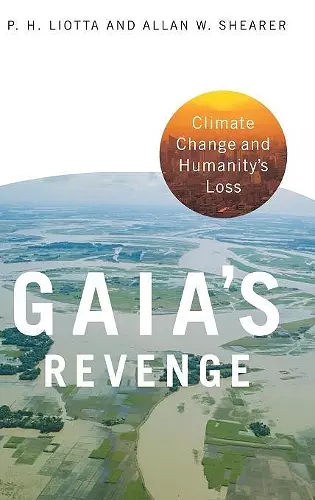
Gaia's Revenge
Climate Change and Humanity's Loss
Allan W Shearer author P H Liotta author
Format:Hardback
Publisher:Bloomsbury Publishing PLC
Published:30th Dec '06
Currently unavailable, and unfortunately no date known when it will be back
"Gaia's Revenge is a sobering rendition of the climate-change discourse. It sharply articulates the link between environment and human security, contributing immensely to a fast-evolving field of study." -- Patricia Kameri-Mbote, Associate Professor and Chair Department of Private Law, School of Law, University of Nairobi "Nuanced, subtle, and meticulously researched, here is the first book welding imminent climate change and multi-faceted national security upheavals into scenarios central in public-policy making." -- John Stilgoe, Harvard University "Liotta and Shearer push us to take seriously the science-practice interface, a needed two-way dialogue between climate scientists and the wider policymaking community. In a time when the newspaper headlines push us to narrow our security frame, the authors set climate change within a broader security context that helps move the issue from disconnected scientific inquiry to pressing policy imperative." -- Geoffrey D. Dabelko, Director, Environmental Change and Security Program
Highlighting the connections between climate change and human security, this book offers an examination of the meaning of climate change and global warming while maintaining a perspective on the implications of environmental effects on all forms of security - national, international, and human.Highlighting the connections between climate change and human security, this book elucidates what might happen when a mere 10-degree drop in average temperature results in a sudden inability to produce enough food, when rapidly advancing desertification produces water scarcities where none existed before, and when newly frozen landscapes lead to more power plants for energy, resulting in increased air pollution. The destabilizing effects of these possibilities create many potential challenges for U.S. national security in a globalized world in which we may have to intervene militarily to safeguard our interests around the globe. In February 2004, a Pentagon report on climate change and its implication for national security received extraordinary attention and publicity. Public attention, however, focused almost exclusively on portents of inevitable doom and disaster—most particularly on a scenario outlining a possible future similar to a climate event of 8,200 years ago and its impact on the availability of food, energy, and water. This book offers a broad examination of the meaning of climate change and global warming while maintaining a strategic perspective on the implications of environmental effects on all forms of security—national, international, and human (transcending borders and having more to do with basic resources). Given the uncertainty surrounding climate change as a specific event, the authors argue for recognizing the profound social, political, and human impact that could take place in the coming years. While recognizing the inherent dangers of prediction, Liotta and Shearer effectively present the case that the time to not only recognize—but deal with—potentially profound outcomes is now.
Liotta and Shearer make compelling cases that offer a broad examination of the meaning of climate change and global warming; within that framework, they maintain a strategic perspective on the implications of environmental effects on security in its broadest sense. Several scenarios are created from the premise above in seven chapters that include rapid climate change; careful examination of security with a focus on the relationship between threats and vulnerabilities; principles behind creating and using scenarios; overview of several methods drawn from the larger literatures of futures and security studies that offer more focused images of the future relative to the context of climate change and societal needs; and finally, a summation that draws all this material together and provides some directions for further thought. This reviewer considers this a factual and unbiased work that reminds us how much remains to be done. Two appendixes explain the abrupt climate change scenario and implications for the US, and a joint science academies statement highlights a global response to climate change. Select bibliography; four-page index. Recommended. Upper-division undergraduates through faculty. * Choice *
It is broad in scope and original in terms of its content and does not go over the ground that is covered in many recent books on global warming. * Environmental Conservatism *
Offering a broad examination of the meaning of climate change and global warming while maintaining a strategic perspective on the implications of environmental effects on all forms of security--national, international, and human. * Natural Resources Journal *
In Greek mythology, Gaia was the goddess of Earth. Her revenge for human accumulation of greenhouse gasses, write the authors, is global warming. How to manage the problem? Liotta and Shearer propose viewing it as a matter of security with climate change perceived as the threat. Environmental degradation, they write, can be a direct threat to health and a contributing factor to conflict; limited natural resources may trigger clashes between of within states The book outlines various scenarios--both grim and hopeful. * Colloquy Alumni Quarterly *
Making the short conceptual leap from a vengeful god to a vengeful planet, Liotta and Shearer look at climate change and human impact, and the continuing failure of decision makers engaged in security to deal with global warming effectively. Their topics include an abrupt climate change scenario and its meaning for security, the fear factor, and the end of the anthropocene. * SciTech Book News *
ISBN: 9780275987978
Dimensions: unknown
Weight: 454g
208 pages