Significant Gestures
A History of American Sign Language
Format:Hardback
Publisher:Bloomsbury Publishing PLC
Published:30th Sep '06
Currently unavailable, and unfortunately no date known when it will be back
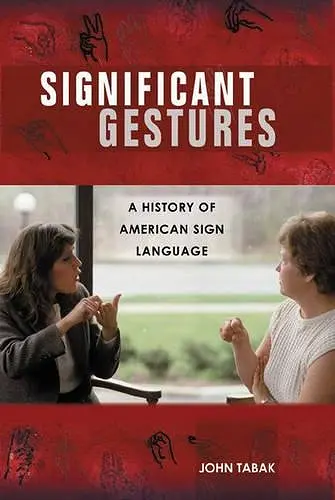
This work provides an overview of the historic, cultural, and linguistic aspects of American Sign Language from the 18th century to the present.
An exploration of Deaf culture in America. This story begins during the first half of the 19th century when a language for the Deaf was introduced, and an educational system was developed to use it. Out of these schools came members of a new American social class, the Deaf who created institutions through which they could participate in society.Tabak has created a fascinating exploration of a unique and uniquely beautiful North American language. The story begins in 18th century France in the first schools to use signed language as the language of instruction. Early in the 19th century a few individuals introduced a variant of this language into the United States and developed an educational system in which to use it. Out of these schools come members of a new American social class, the Deaf—with a capital D—who, united by a common signed language, create institutions through which they can participate in society on terms equal to those of other constituent groups. This strategy proved extremely controversial among all but the Deaf. The controversy lasted a century, during which time American Sign Language evolved along racial lines and in response to the pressures of those who sought to eliminate the use of American Sign Language. Today, new ideas in art, science, and education have supplanted much of the old opposition to American Sign Language and Deaf culture. New legislation and new technologies have also had profound effects on the lives of American Deaf. As a consequence, American Sign Language is evolving faster than ever before.
For some time it seemed to be the beginning of a culture, a start on a language, but it was not until those who lived the culture and used the language gained recognition as self-reliant that both the Deaf culture and American Sign Language (ASL) were acknowledged as valid. Tabak, who has a personal and professional interest in ASL, describes the remarkable French cleric who taught an early form of sign language, then traces the forces of opposition, many of which insisted on oral speech rather than signing, and describes the growth of ASL into a recognized language. He also shows the side roads, including forays into race, and how modern concepts of modality started to work for ASL. He details the path of the deaf and blind within ASL and explains technologies that are (and are not) gaining ground in the Deaf and ASL communities. * Reference & Research Book News *
ISBN: 9780275989743
Dimensions: unknown
Weight: 510g
240 pages