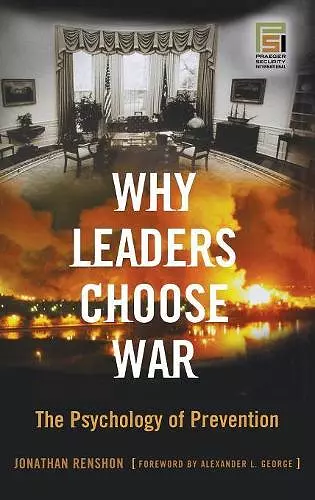
Why Leaders Choose War
The Psychology of Prevention
Format:Hardback
Publisher:Bloomsbury Publishing PLC
Published:30th May '06
Currently unavailable, and unfortunately no date known when it will be back
"Jonathan Renshon makes a contribution not only to the current debates about the strategic sense of preventive war but also to the longer term questions of the circumstances in which political leaders consider launching this type of action. The case studies demonstrate just how complex such decisions can be." -- Professor Sir Lawrence Freedman, Department of War Studies, Kings College London "Although some claim that the emphasis on preventive action in the Bush Doctrine and in the American war in Iraq is a clear departure from two centuries of American foreign policy, and perhaps from the conduct of diplomacy more generally, Why Leaders Choose War provides a convincing demonstration of the central role of prevention in the international politics of the last half century and before. Renshon's emphasis on the psychology of political leaders breaks new theoretical ground in the analysis of prevention, and his historical studies of cases in which prevention was seriously considered are well researched and quite informative. Renshon offers an important perspective on a critical issue of contemporary security policy in uncertain times." -- Jack S. Levy, Board of Governors' Professor, Department of Political Science, Rutgers University "As timely as today's headlines, Renshon's work will require scholars to reconsider their understanding of the process of preventive military action. In arguing that leaders and their perceptions play an influential role in these choices, this book provides must reading for those interested in understanding the complex dynamics of decisions to use force. Scholars and the informed citizen alike have much to learn from this insightful volume." -- Douglas C. Foyle, Assistant Professor, Government Department^LWesleyan University "A remarkable debut book by a young scholar that augurs for an outstanding academic career. Using a sophisticated comparative case study approach, Why Leaders Choose War adds substantially to our understanding of leaders' motivations for preventive war." -- Jerrold M. Post, Professor of Psychiatry, Political Psychology and International Affairs, Director, Political Psychology Program, Elliot School of International Affairs, George Washington University
Presents a theory of preventative action based upon the beliefs and perceptions of leaders. This book examines five cases: British action in the Suez Canal Crisis, 1956; Israel's strike on Iraq's nuclear reactor, 1981; American preventive war planning, 1946-1954; Indian preventative war planning, 1982-2002; and America's war against Iraq, 2003.Preventive war has a long history in international politics, but until it became an instrumental part of the Bush Doctrine, it was mostly overlooked. Renshon argues that the best avenue for understanding decisions to initiate preventive action is through a close examination of the individual leader responsible for such decisions. In this work, he develops a theory of psychological motivations for preventive action. By examining five situations, including the Iraq war, he pinpoints the factors that matter most in decisions to take preventive military action. There have been preventive wars throughout history, but the motivations behind them have remained elusive, and many crucial questions remain unanswered. What exactly constitutes preventive action? What differentiates preventive action from pre-emptive action? Are there significant differences between preventive strikes and full-on preventive wars? What is the relationship of preventive action to traditional concepts of deterrence, compellence, and international law? Finally, why do states initiate preventive action? Renshon argues that the best avenue for understanding decisions to initiate preventive action is through a close examination of the individual leader responsible for such decisions.
The old American way of war, in which problems abroad were avoided until they spilled over and directly threatened American security interests, has been superseded by the new Bush doctrine of preventive attack. Renshon, writing while still in the PhD program at Harvard, uses the lens of political psychology to examine five historical cases of prevention. These include American war planning from 1946 to 1954; British action in the 1956 Suez Crisis; Israel's bombing of Iraq's nuclear reactor in 1981; Indian preventive war planning from 1982 to 2002; and America's preventive war plan against Iraq in 2003. Renshon's theory of psychological motivations highlights six factors thought to influence the preventive war decision, including declining relative power, bad faith image of the adversary, a conviction that war is inevitable, the perception that there is a brief window of opportunity in which to act, a situation that appears to favor a first strike, and black-and-white thinking. These are filtered through the psychology, beliefs, and judgments of individual leaders, supplemented by discussions of governing constraints, personal dynamics including risk tolerance, and state reputation. Ultimately, Renshon argues the most profitable manner in which to understand preventive war is through a detailed psychological examination of individual leaders. Highly recommended. Upper-division undergraduates through faculty. * Choice *
[I]t will interest many psychologists (particularly psychologists who are interested in history and politics). Renshon provides an interesting analysis of the choices for and against preventive war and places these events within important historical contexts. Furthermore, he helps the reader appreciate the difficult decisions world leaders face when responding to adversarial actions by other countries….[w]orth reading. * PsycCritiques *
Renshon's analysis is sure to capture the attention of policymakers, scholars, and students alike (including my own undergraduate honors students, among whom the book inspired lively debate), and makes a strong contribution to security studies and to political psychology….I strongly and wholeheartedly recommend Why Leaders Choose War: The Psychology of Prevention, as is fosters critical thought and contributes to theory building by placing leaders front and center in explaining why countries make the consequential decisions to advocate or to oppose preventive war or preventive strikes. An engaging read for a variety of different audiences. * Political Science Quarterly *
Jonathan Renshon's purpose in this engaging and useful book is to help us better understand the conditions under which leaders well resort to preventive military action. Correctly noting that this is an understudied yet important question, Renshon methodically sets out to point us in the direction of answers….The case studies are clearly written, well-researched, and efficient. Indeed, readers interested only in the cases themselves will find them very useful as capsule histories….[h]e sets out merely to take the first steps down the road to a comprehensive theory. This he has certainly done. May the journey continue. * Political Psychology *
Renshon examines the US invasion of Iraq, President Eisenhower's rejection of preventive war against the USSR, British-French-Israeli war against Egypt in 1956, Israel's bombing of Iraq's Osirak nuclear reactor in 1981, and two decades of India-Pakistan conflicts to explore why leaders opt for preventive war or not. He investigates the causal weight of five factors that may contribute to a decision for preventive war; declining power in relation to an adversary, an inherent bad faith image of the adversary, a belief that war or serious conflict is inevitable, the belief that there is only a short window in which to fact, and a situation that is believed to favor the offensive. In the end he finds that it is the psychology of the individual leader that will tip the decision the one way or another, even in the presence of all five of the factors. * Reference & Research Book News *
ISBN: 9780275990855
Dimensions: unknown
Weight: 539g
240 pages