Prisoners of War
A Reference Handbook
Format:Hardback
Publisher:Bloomsbury Publishing PLC
Published:30th Nov '07
Currently unavailable, and unfortunately no date known when it will be back
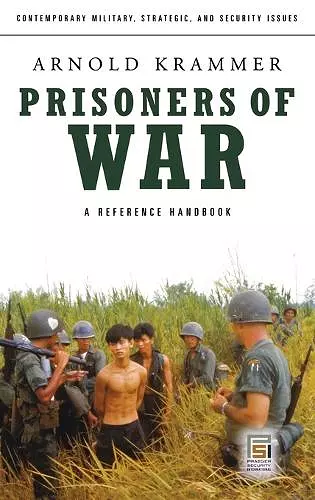
Krammer examines the history of prisoners of war from biblical times to the modern era. The narrative is supported by primary documents, biographies of relevant participants in history, and a bibliography to serve as a springboard for additional research.
America's current War on Terror is causing a readjustment of centuries of POW policies. Prisoners of war are once again in the news as America and Western Europe grapple with a new, faceless enemy and the rules of war and the torture of POWs are open to reconsideration. Until very recently, there has been astonishingly little written on the subject of prisoners of war. Yet, to understand the present, it is critical to look back over history. To that end, Arnold Krammer examines the fate of war prisoners from Biblical and Medieval times through the halting evolution of international law to the current reshuffling of the rules. The issue of prisoners of war is of more immediate concern now than ever before and an examination of the history of their treatment and current status may well influence foreign policy. The fate of war prisoners through history has been cruel and haphazard. The lives of captives hung by a thread. Execution, enslavement, torture, or being held for ransom were equally likely. International agreements developed haltingly through the 19th and 20th centuries to culminate in the Geneva Accords of 1929. America's current War on Terror is causing a readjustment of centuries of POW policies. Prisoners of war are once again in the news as America and Western Europe grapple with a new, faceless enemy and the rules of war and the torture of POWs are open to reconsideration. Until very recently, there has been astonishingly little written on the subject of prisoners of war. Yet, to understand the present, it is critical to look back over history. To that end, Arnold Krammer examines the fate of war prisoners from Biblical and Medieval times through the halting evolution of international law to the current reshuffling of the rules. Since biblical times, war captives have been considered property and counted as booty to be enslaved or killed. Americans were interested in generals and weapons and battles, but not the fate of prisoners of war. The Second World War, when 90,000 Americans fell into enemy hands, began to change that. Concern for our POWs in Germany and Japan, and close contact with enemy camps in America began to change our attitudes. However, it was the Vietnam War, media-driven and polarizing,...
What to do with captured enemies in wartime is an ancient problem. Solutions vary with the prevailing mores and concepts of warfare. Since 2001, the US has conducted an ill-defined war on terrorism against enemies that allegedly do not qualify as soldiers under international law and therefore may be denied protection as prisoners of war (POWs). Krammer, a master of POW history, addresses fluctuating ways captors have treated war captives since earliest historical times. He discusses cases of prisoner parole, exchange, ransom, incarceration, enslavement, torture, religious sacrifice, and mass murder, and traces the irregular expansion of protection for POWs since Hugo Grotius defined the issue in terms of natural law in 1625. Krammer supports his narrative with extensive excerpts from military regulations and international agreements that clarified the status and rights of POWs during the 19th and 20th centuries. He refers particularly to Hague conferences of 1899 and 1907 and Geneva conventions of 1929 and 1949. Although terrorism is not new, Krammer seems to agree that recent styles of irregular conflict have introduced new conditions that reduce the effectiveness of international law in protecting POWs. Bibliography includes Internet references. Recommended. All levels/libraries. * Choice *
The book begins with a simple truth: throughout the ages, soldiers have been fortunate to be taken prisoner when the enemy's blood is up. Using examples from ancient to modern wars, Krammer argues that it is much easier and far more convenient to kill surrendered soldiers rather than take the trouble and bear the expense of capture….While this book is not a comprehensive history of the POW experience, it is a first of its kind in terms of simplicity of approach, sequence of topics, historical frankness, and brutal honesty….Arnold Krammer has created something really significant for a master scholar: a primer, a place to start for anyone wanting to seriously examine and probe the complexity of captivity through the ages. Without a doubt, this book is a solid and welcome contribution to the field of historical POW studies. * The Journal of Military History *
ISBN: 9780275993009
Dimensions: unknown
Weight: 454g
216 pages