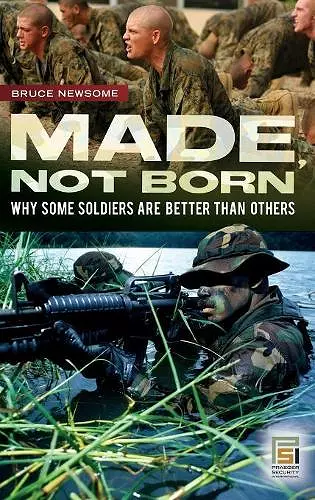
Made, Not Born
Why Some Soldiers Are Better Than Others
Format:Hardback
Publisher:Bloomsbury Publishing PLC
Published:30th Sep '07
Currently unavailable, and unfortunately no date known when it will be back
"Newsome zeroes in on a subject analysts often ignore-how good are a country's soldiers? When studying warfare, we tend to focus on weaponry and wealth, on generals and statesmen, on battle plans and grand strategies. Yet soldiers matter as much as all the above. At a time when our policies from Iraq and Afghanistan to Congo and Colombia depend on helping other countries develop strong, effective, dependable militaries-which are only attainable if they have good soldiers to fill them out--Newsome's approach could hardly be more timely." -- Michael O'Hanlon, Senior Fellow, Brookings Institution "An impressively comprehensive and trenchant investigation of one of the most important but understudied issues in military effectiveness." -- Richard K. Betts, Director, Saltzman Institute of War and Peace Studies, Columbia University "The defense planning community has tended to overemphasize material contributors to combat effectiveness, with potentially serious consequences. Bruce Newsome helps to correct this tendency with a wide ranging tour d'horizon of one of the most important nonmaterial contributors: the performance of the individual soldiers that comprise the military organization." -- Dr. Stephen Biddle, Senior Fellow, Council on Foreign Relations
Why do the combat capabilities of individual soldiers vary so much? In this first social scientific study of the effectiveness of combat troops, Newsome evaluates competing explanations for the varying combat capabilities and performances.
There are four main explanations, each emphasizing the influence of a single factor.
Why do the combat capabilities of individual soldiers vary so much? This book seeks to provide an answer to this and other questions about variability in combat performance. Some soldiers flee quickly from the battlefield, while others endure all hardships until the bitter end. Some combat units can perform numerous types of missions, while others cannot keep themselves organized during peacetime. Some militaries armed with obsolete weapons have out fought enemies with the latest weapons, just as some massively outnumbered armies have beaten back much larger opponents. In this first social scientific study of the effectiveness of combat troops, Newsome evaluates competing explanations for the varying combat capabilities and performances.
There are four main explanations, each emphasizing the influence of a single factor. The first focuses on material endowments. How well funded are the troops? Do they have the latest protective gear and the most advanced weaponry? Second, some analysts claim that democracies produce better commanders, superior strategies, more motivated personnel, or better-managed personnel; others, however, associated those characteristics with more authoritarian forms of government. Third is the idea that giving more power to the troops on the ground in individual combat units empowers them with decision-making capability and adaptability to fast-changing situations and circumstances. Newsome presents evidence that decentralized personnel management does correlate with superior combat performance. Fourth, soldier capabilities and performance often are assumed to reflect intrinsic attributes, such as prior civilian values. Newsome argues that the capabilities of combat soldiers are acquired through military training and other forms of conditioning, but he does not entirely discount the role of a soldier's individual character. In the age-old nature vs. nurture argument, he finds that intrinsic qualities do count, but that extrinsic factors, such as training and environment, matter even more.
"Newsome tackles the question of whether good soldiers are born or made in this well-researched, important book. He argues that the capabilities and performance of combat personnel are a function of the military training, socialization, and aspects of the conditioning designed into the system that produces a soldier. The notion that the military itself produces good soldiers runs counter to much of the military sociology literature, which typically focuses on the intrinsic qualities of those who choose and succeed within a career in the armed forces, essentially concluding that some have what it takes to be a good soldier and some do not. Newsome's thesis is an instructive one. If soldiers are made, not born, then the structure of the military training and socialization process is the key to combat performance; different military training processes yield different levels of combat effectiveness. Consequently, the performance levels of a nation's military can be improved with innovations in training and conditioning. The research design is excellent and the book is well grounded in theories from numerous perspectives: political, sociological, organizational, and psychological. Recommended. Graduate, research, and professional collections." - Choice
ISBN: 9780275998301
Dimensions: unknown
Weight: unknown
216 pages