Popularizing Japanese TV
The Cultural, Economic, and Emotional Dimensions of Infotainment Discourse
Format:Paperback
Publisher:Taylor & Francis Ltd
Published:30th Jun '20
Currently unavailable, and unfortunately no date known when it will be back
This paperback is available in another edition too:
- Hardback£171.99(9781138680609)
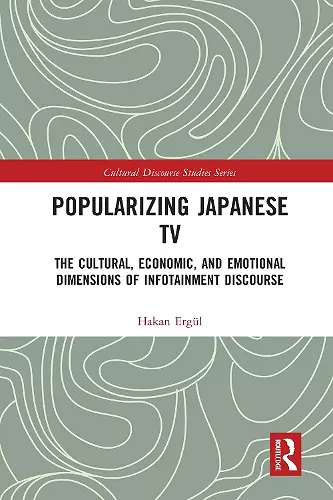
Over the past years, the view has emerged that Japanese TV is dominated by an infotainment mode of discourse. The book extends this view, detailing and interpreting the cultural, economic, and emotional dimensions of this communication phenomenon from an ethnographic perspective. It examines the complex ways in which infotainment works in an advanced capitalist society. As such, this is more than a book about Japan; it is a work that fits within media ethnography and cultural studies, and appeals to readers interested in the question of how television, at the heart of the global media stream, successfully turns into a persuasive, intimate, and powerful member of a televisual audience-family through carefully engineered televisual discourses, linguistic/non-linguistic component, audiovisual strategies, and economic and cultural elements.
Drawing on ethnographic observations in TV stations in two major cities, Sendai and Tokyo, the book reveals several essential components embedded within infotainment discourse. Thus, this book not only provides a panoramic picture of a core phenomenon in Japanese broadcasting since the 2000s but also discusses how both cultural discourses and economic considerations influence contemporary television broadcasting.
'Often the best insights come from the margins. We understand the familiar only when it is made strange. So it is with Hakan Ergül’s excellent, readable, well-organized, scholarly and insightful study. Hybridizing TV genres adapt to Japanese culture –– from sideshow to "wideshow" –– to create a unique emotional-physical space called uchi. Here, an intimate sense of "we" community grows out of commodified infotainment; the cultural out of the commercial. Read this book, and you’ll understand how popular television works. It’s a journey full of "danger and promise" for audiences and analysts alike.'— John Hartley, John Curtin Distinguished Professor, Professor of Cultural Science, Curtin University, Western Australia
'[The] blending of information and entertainment Hakan Ergül examines and explicates in this timely, comprehensive and well-written book. It is of particular value because it not only examines the content of the pervasive "infotainment" shows, but also examines through the author’s first hand fieldwork processes of production and the conception of such shows, their role in the wider consumer economy of Japan, the subtle processes through which they influence the emotional structures of contemporary Japanese society, and very significantly, the way in which, in Ergül’s argument, they contribute to creating and reproducing an admittedly virtual, but nevertheless very real, sense of intimacy between actors/presenters and viewers, and between viewers themselves, who become part of a kind of a virtual community through "participation" in favorite shows. [...] As the study of popular culture has moved to center stage in scholarly discourse, this book shows how it can be extended and deepened, while situating it in the field of Japanese studies and making it accessible to the scholar of comparative forms of popular expression and media.'— John Clammer, Professor of Sociology, O.P. Jindal Global University
'Hakan Ergül’s book opens up an exciting new analysis of Japanese television from a perspective that has not before been approached in the English language. Although couched in the somewhat technical-sounding language of infotainment discourse, there is much to learn about Japan and its viewing public here too. Ergül’s research was with all aspects of Japanese television: viewing it, of course, but also conducting participant observation with those who make it and examining its impact on the regular viewers in one large but local venue in the Tohoku area. The analysis is placed in the context of a range of anthropological and linguistic studies of Japan in a way that demonstrates how the fascinating combination of information and entertainment that we can all watch when we visit Japan cleverly becomes a veritable part of the Japanese home. As the sub-title tells us, the book also reveals much about "the cultural, economic and emotional dimensions" of the process, and I recommend it as a brilliant insight into a quite ubiquitous area of Japanese life.' — Joy Hendry, Professor Emerita, Oxford Brookes University
ISBN: 9780367583590
Dimensions: unknown
Weight: 340g
166 pages