Passive Patient Culture in India
Disrespect in Law and Medicine
Format:Hardback
Publisher:Taylor & Francis Ltd
Published:21st Mar '25
Currently unavailable, and unfortunately no date known when it will be back
This hardback is available in another edition too:
- Paperback£47.99(9780367655372)
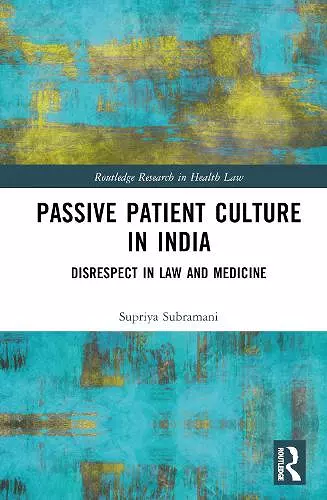
In a society shaped by deep inequalities, where healthcare and legal systems often reinforce class, caste, religion, and gender hierarchies, this book offers a powerful examination of patienthood in India. Through its critical approach, it seeks to disrupt binaries—such as universalistic and particularistic values and data versus theory—while decentering normative discourses by foregrounding lived experiences within the context. It offers philosophical and conceptual insights that extend far beyond local variations and contexts, challenging dominant narratives in global discourses on medical decision-making and concepts such as informed consent, autonomy, and respect.
This book critiques the archetype of the “passive patient” entrenched in both medicine and law in India — an image that undermines agency, diminishes self-respect, and sustains a culture of disrespect. Chapters of the book unpacks the intersections of power, social categories, and patienthood, exposing how marginalized communities face everyday indignities in healthcare and law. It explores law and medicine’s role in maintaining presumed 'passive patient' archetype, especially through legal judgements and healthcare encounters. This book advocates for reimagining patienthood as centered on self-respect, recognition, and agency, arguing that the “passive patient” is not an isolated phenomenon but an outcome of broader, oppressive structures.
Contributing to robust debates in medical sociology, bioethics, and social justice, this book is essential reading for those interested in the intersections of these fields, along with applied ethics, health services research, and law.
This book is freely available as downloadable Open Access PDFs at http://www.taylorfrancis.com under a Creative Commons Attribution-Non Commercial-No Derivatives (CC-BY-NC-ND) 4.0 license.
“Supriya Subramani’s book is a pioneering attempt to explore [the] dark side of Indian healthcare. The study is enriched by her own experience of everyday indignities from childhood onwards. The book will be of much interest to privileged and underprivileged readers alike. For those who have also been at the receiving end of everyday indignities, it will be a source of strength and inspiration. If you come from the other end, this book will help you to open your eyes to patterns of disrespect that are too often taken for granted."
-Jean Drèze, Development Economist and Social Scientist
"Passive Patient Culture in India is one of the finest works of philosophy that I have read in a long, long time. It is exemplary in the manner in which philosophical analysis and reflection are exercised in service of the marginalised, rather than the sadly more common tendency whereby the marginalised are commodified for the benefit of academic enterprise. Subramani has much to teach social and political philosophers, bioethicists, the legal community, health humanities scholars, those working in development, and health practitioners of all stripes. While the book title begins to locate the communities with whom Subramani laboured in the production of this text, it has important lessons for us all - geography, class, gender and caste notwithstanding."
-Bryan Mukandi, Philosopher
"The title of this book is deceiving. It should in fact be called something like “Respect and Recognition: A New and Urgent Manifesto for an Ailing World.” Because it is a must-read for anyone interested in challenging themselves, their disciplinary norms, and their institutional cultures – to think deeply about the structural inequalities that shape our worlds and work towards overcoming them in any area in which we practice. It should be required reading for all. Subramani’s work has already changed the way I think about the research that I do in history, and the way in which I do it. The introduction alone was breathtaking in its intellectual reach, its connective sinews, and its critical, yet hopeful arguments. This book left me in tears, and yet deeply inspired – to dare to dream about how to do things differently, and to get on with trying."
-Michael A. McDonnell, Historian
"This book is an important addition to the ethnographies of medical practice. By focussing on the notion of passivity of patients, Subramani provides a framework to understand ideas of autonomy, agency and being an active subject, not only in the context of medicine but also as a human condition. Drawing on extensive ethnography, the book provokes questions about the meaning of the word 'patient', and challenges our passive acceptance of the passivity of being a patient. The most important aspect of the book is its focus on the treatment of patients from disadvantaged and marginalised members of a society. The insightful ethnographic work on this aspect should make us think about the urgency of activating the idea of humans in medical practice today. By arguing for the importance of notions such as self-respect, this book gives us a framework to put the missing human back into medical science."
-Sundar Sarukkai, Philosopher and Writer
"Supriya Subramani’s book breaks through traditional disciplinary boundaries, representing a significant step forward in in the fields of medical ethics, law, sociology, and social justice studies. Using India as an example, her approach will influence global theoretical and methodological debates. Her perspective on the phenomenology of power, structural inequality and disrespect in doctor-patient interactions, as framed by conceptions of self-respect, dignity, and recognition, constitutes high-impact research. It addresses issues that traditional normative medical ethics fails to consider and critiques aspects that conventional forms of empirical ethics fail to understand. This is an important and richly rewarding book for our times."
-Thomas Gutmann, Professor, Department of Philosophy, Religion and Politics, University of Münster
ISBN: 9780367655365
Dimensions: unknown
Weight: 530g
182 pages