The Genesis and Structure of the Hungarian Jazz Diaspora
Format:Paperback
Publisher:Taylor & Francis Ltd
Published:29th Jan '24
Currently unavailable, and unfortunately no date known when it will be back
This paperback is available in another edition too:
- Hardback£171.99(9780367677794)
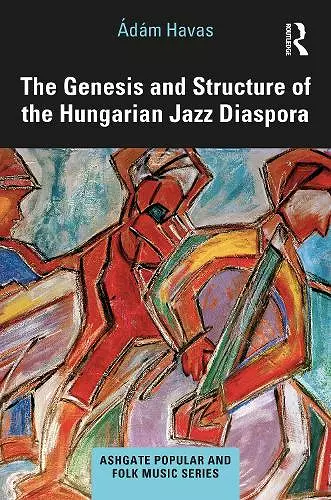
In Hungary, jazz was at the forefront of heated debates sparked by the racialised tensions between national music traditions and newly emerging forms of popular culture that challenged the prevailing status quo within the cultural hierarchies of different historical eras. Drawing on an extensive, four-year field research project, including ethnographic observations and 29 in-depth interviews, this book is the first to explore the hidden diasporic narrative(s) of Hungarian jazz through the system of historically formed distinctions linked to the social practices of assimilated Jews and Romani musicians. The chapters illustrate how different concepts of authenticity and conflicting definitions of jazz as the "sound of Western modernity" have resulted in a unique hierarchical setting. The book's account of the fundamental opposition between US-centric mainstream jazz (bebop) and Bartók-inspired free jazz camps not only reveals the extent to which traditionalism and modernism were linked to class- and race-based cultural distinctions, but offers critical insights about the social logic of Hungary’s geocultural positioning in the ‘twilight zone’ between East and West to use the words of Maria Todorova. Following a historical overview that incorporates comparisons with other Central European jazz cultures, the book offers a rigorous analysis of how the transition from playing ‘caféhouse music’ to bebop became a significant element in the status claims of Hungary’s ‘significant others’, i.e. Romani musicians. By combining the innovative application of Pierre Bourdieu’s cultural sociology with popular music studies and postcolonial scholarship, this work offers a forceful demonstration of the manifold connections of this particular jazz scene to global networks of cultural production, which also continue to shape it.
What a complex, brilliant little book! It’s best to read it as
• a tour de force in the ethnography of performing arts, putting the field of jazz in Hungary on the map of the social sciences world-wide,
• a courageous renewal of the Bourdieusian dialect of sociology, from the sidelines of European bourgeois modernity,
• an ethnography of the place of ‘race’ and identity as they appear in the cosmos of the creative arts, and dance in the double bind of Dirty Whiteness and (dis)privilege,
• an insider-outsider take on the whirl of radically open-ended art,
• an account of creative lives that vibrate between bebop inspirations and the “burden of free idioms”, negotiating the all-important informal scripts played in the “Roma” and “assimilated Jewish” scenes, and
• a sparkling allegory for semiperipheral east-central Europe, a tiny universe of its own, forever in search of a sound—finding a voice that it can regard as its own.
József Böröcz, Professor of Sociology, Rutgers, The State University of New Jersey, USA
What a complex, brilliant little book! It’s best to read it as
• a tour de force in the ethnography of performing arts, putting the field of jazz in Hungary on the map of the social sciences world-wide,
• a courageous renewal of the Bourdieusian dialect of sociology, from the sidelines of European bourgeois modernity,
• an ethnography of the place of ‘race’ and identity as they appear in the cosmos of the creative arts, and dance in the double bind of Dirty Whiteness and (dis)privilege,
• an insider-outsider take on the whirl of radically open-ended art,
• an account of creative lives that vibrate between bebop inspirations and the “burden of free idioms”, negotiating the all-important informal scripts played in the “Roma” and “assimilated Jewish” scenes, and
• a sparkling allegory for semiperipheral east-central Europe, a tiny universe of its own, forever in search of a sound—finding a voice that it can regard as its own.
József Böröcz, Professor of Sociology, Rutgers, The State University of New Jersey, USA
'I am promoting a fascinating, inspiring and lively lecture in the seminar series of the Department of Political Science at CEU. Presenting his new book, The Genesis and Structure of the Hungarian Jazz Diaspora (N.Y.: Routledge, 2022), Ádám Havas offered a global socio-cultural, conceptual history of the subject. Accordingly, Hungarian jazz had emerged in the interwar period via the collaboration of Jewish and (in the era’s phrase) Gipsy musicians. Through integrating tradition, innovation, and emulation, these multiclass/multiculture teams - both dissidents from and loyal to their own cultural contexts - created qualitatively new music, and thereby subverted traditional socio-cultural hierarchies. So unique and attractive the new „Global Southern” variant had become that, after and despite the seas of blood let by perpetrators of the Holocaust and Porajmos, and then despite being banned during Hungary’s Stalinist period, Hungarian jazz not just survived, but – albeit only through forced emigration of its cultivators - could be successfully re-exported to the USA and Western Europe. Later, tolerated or even promoted by János Kádár’s soft dictatorship, jazz returned to and became, somewhat surprisingly, part of high culture in Hungary. I could go on with what else I learned ... So good to have the opportunity for breaking free from the "iron cage" of the abstract, general, and bloodless categories of increasingly "sciency" social science.'
Professor Béla GreskovitsUniversity Professor at the Department of International Relations, and Department of Political Science, at Central European University, Vienna, Austria, recipient of the Stein Rokkan Prize for Comparative Social Science Research (2013) for his book Capitalist Diversity on Europe's Periphery, written together with Dorothee Bohle, and published by Cornell University Press in 2012.
'Focusing the processes which have shaped jazz in Hungary as an autonomous cultural field, it reveals the agency of ‘other’ jazz practices with the explicit objective to reconfigure center-periphery relations only too well-known from dominant US-centered jazz historiography. Writing from a geopolitical and epistemological position at the margin (in Hungary, jazz studies – a “disciplinary vacuum” as described by the author – is only at the very beginning in an Academia trying to survive the Fidesz regime), one cannot underestimate the intellectual effort and stamina to craft this book.'
Professor André DoehringUniversity of Music and Performing Arts Graz, Head of the Institute for Jazz Research
'A sociologist by training, Ádám Havas has mobilized an impressive theoretical apparatus to map the path of domestic jazz with its shifting cultural status, meanings, subgenres, and internal fault lines. Pierre Bourdieu’s cultural sociology is effectively combined with postcolonial studies and new jazz studies. We must moreover welcome his erudition and analytic skills brought to bear on an internationally barely known jazz diaspora in a small semi-peripheral country like Hungary.'
Anna SzemereAuthor of Up From the Underground: The Culture of Rock Music in Postsocialist Hungary (2001)
'In order to place jazz music within the Hungarian national culture, the author not only gives attention to the East-West division of the music but also investigates the role of Hungarian jazz in the context of Central European culture. The book examines the contribution of musicians with Romani and Jewish origins in the transformation of jazz from café to bebop style, which has led to the contemporary global form of the genre.'
Yvetta KajanováProfessor of Musicology at Comenius University in Bratislava
ISBN: 9780367677824
Dimensions: unknown
Weight: 453g
186 pages