Disturbance Ecology and Biological Diversity
Context, Nature, and Scale
Dominick A DellaSala editor Erik A Beever editor Inger Suzanne Prange editor
Format:Paperback
Publisher:Taylor & Francis Ltd
Published:15th Nov '19
Currently unavailable, and unfortunately no date known when it will be back
This paperback is available in another edition too:
- Hardback£190.00(9781482298710)
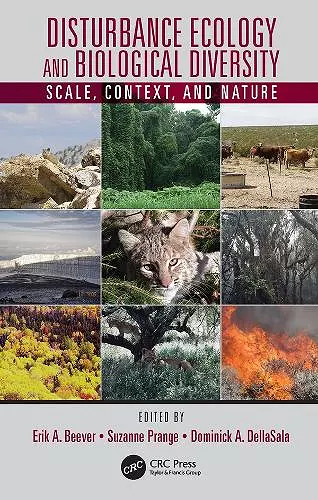
In contexts outside of ecology, the term "disturbance" carries a variety of negative connotations. Within ecology, however, disturbances are neither inherently negative nor positive for ecological systems; instead, their effects depend on the context, scale, and species involved. As ecologists better understand these context-dependencies, the field of disturbance ecology has matured, diversified, and become more complex and nuanced over the past several decades.
Ecological Disturbance: Scale, Context, and Nature unites a collection of perspectives that weave together the topics of disturbance ecology and biological diversity. Chapters cover wildfire, disease, herbivory, surface mining, land-use conversions, and forest harvest, among numerous other natural and anthropogenic influences on ecosystems. The book begins with an introduction that reviews how thinking on perturbations and community organization has evolved over the last century, then explores how disturbances might be meaningfully categorized, and how biological diversity has been conceptualized. The introduction also explores the roles of scale and ecological context in disturbance outcomes, and reviews recent analytical and methodological advances relevant to disturbance ecology. The book then moves into forested ecosystems, where much of the early literature on disturbances arose, and focuses on scale-dependence, relationships of natural and anthropogenic disturbance, and recovery or successional trajectories. The next section focuses on emerging disturbances amidst global change, including non-native species, disease, and synergies with other disturbances. The book ends with a section on land-use disturbance, focusing on landscape pattern, resilience, and recovery dynamics. Throughout, the book’s material spans a wide diversity of spatial and temporal scales, disciplines, taxa, and levels of ecological organization.
This book may be used in a seminar course, as a compendium for disturbance ecology curricula that are at the interface of conceptual and applied ecology, and in other circumstances to illustrate how different authors have handled the various pragmatic challenges that arise in studies that ask broader questions. In an era of unprecedented global change, this book constitutes a valuable source for researchers, students, natural resource managers, and other conservation practitioners interested in delving deeper into disturbance ecology.
ISBN: 9780367861773
Dimensions: unknown
Weight: 390g
192 pages