Imagination from Fantasy to Delusion
Format:Paperback
Publisher:Taylor & Francis Ltd
Published:3rd Jul '12
Currently unavailable, and unfortunately no date known when it will be back
This paperback is available in another edition too:
- Hardback£171.99(9780415875707)
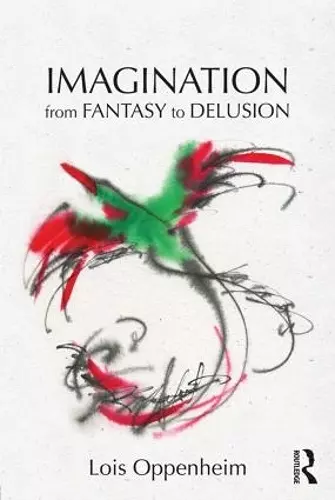
In Imagination from Fantasy to Delusion, Lois Oppenheim illustrates the enhancement of self that creativity affords, the relationship of imagination to the self as agent. The premise of this book is twofold: First, that the imaginary is real. Where it differs from what we commonly take to be reality is in structure and in form. The imaginary of art, for example, is not illusionary for it is phenomenologically describable and even depictable, as demonstrated by the self-reflexive efforts of modernist painters and writers. No less real than the imaginary of art, and thus fantasy, is the imaginary of delusion, ascertainable in the very function it serves. Though fundamentally different, fantasy and delusion do share a significant feature: a preoccupation with agency. Second is that change, the enhancement of self through an increase in agency, is facilitated by the biology of reward: The pleasure of increased self-cohesion—the efficacy acquired through knowledge of, and the attribution of meaning to, the world—is ultimately the sine qua non of imaginative thought.
Oppenheim emphasizes the idea that imagination generates knowledge. Our sensory systems, like our higher cognitive functions, give the human brain knowledge to maintain the homeostatic balance required for survival and to enrich the sense of self required for agency. And, she suggests, imagination is a function of their doing so. Moreover, she explores the construct by which we apprehend the workings of imagination—fantasy—and considers in what the mental imagery that endows it consists, how fantasy may be transmitted transgenerationally, and how delusion can be an impediment to imagination while also being a product of it. Additionally, she likens psychoanalysis to the making of art as a process of acquiring knowledge and looks at creativity itself as a coming-to-know.
Throughout this book, there run several opposing threads. The first is that of the intra- and interpsychic psychoanalytic paradigms. This theoretical contrast bears on our understanding of aesthetic experience as sublimatory versus object relational and on our understanding of the construction of meaning. A second opposition resides in the notion of agency (with its implication of self-cohesion) which has everything to do with ego function and, seemingly, the usefulness of "unconscious fantasy," a cornerstone of psychoanalysis now thrown into question by the postmodern favoring of dissociation over repression and other mechanisms of...
"This fascinating, illuminating book provides a psychoanalytic cornucopia of observations and theories relevant to imagination. The consideration of diverse phenomena (e.g., aesthetics, fantasy, and trauma) and new concepts of memory stimulate and expand contemporary thought and inquiry. Dr. Oppenheim notes that imagination is part of the information processing function of the human mind. Her book exemplifies the pleasurable aspect of imagination which increases self-agency and self-cohesion. The inclusion of interviews of artists adds an intimate, vivid discourse at the intersection of personality and creativity. The reader will appreciate the distinguished author and scholar's exposition of the psychobiology of the brain's reward system, while being rewarded by her creative endeavors."- Harold P. Blum, M.D., Training and Supervising Analyst, Institute for Psychoanalytic Education
"Lois Oppenheim has written an important and inspired book that uses her broad interdisciplinary knowledge to render a linking of art, philosophy, and neuropsychoanalysis. In her previous work she has written deeply insightful studies of Paul Klee, Samuel Beckett, and Martha Graham. In her work she is advancing a theory of creativity that is not limited to applied psychoanalysis, or reductionist neuroscience. It is an unusual multi-aspectual view of imagination, fantasy and its intergenerational transfer, creativity, and artistic process. The reader will be both challenged and delighted as this book brings forth its enriched and novel point of view. The author’s case studies of the artist children of artists are fascinating, insightful and engaging. Remarkable is the elegance and clarity of her writing; she renders complex ideas lucid, understandable, and above all interesting."- David D. Olds, M.D., Training and Supervising Analyst , Columbia University Center for Psychoanalytic Training and Research; Co-Editor, Neuropsychoanalysis
ISBN: 9780415875714
Dimensions: unknown
Weight: 180g
240 pages