When Crime Appears
The Role of Emergence
Christopher Sullivan editor Leslie Kennedy editor Jean McGloin editor
Format:Paperback
Publisher:Taylor & Francis Ltd
Published:19th Oct '11
Currently unavailable, and unfortunately no date known when it will be back
This paperback is available in another edition too:
- Hardback£187.99(9780415883047)
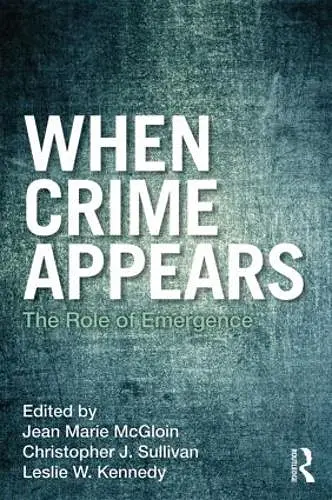
In recent years, the idea of emergence, which suggests that observed patterns in behavior and events are not fully reductive and stem from complex lower-level interactions, has begun to take hold in the social sciences. Criminologists have started to use this framework to improve our general understanding of the etiology of crime and criminal behavior. When Crime Appears: The Role of Emergence is concerned with our ability to make sense of the complex underpinnings of the end-stage patterns and events that we see in studying crime and offers an early narrative on the concept of emergence as it pertains to criminological research. Collectively, the chapters in this volume provide a sense of why the emergence framework could be useful, outlines its core conceptual properties, provides some examples of its potential application, and presents some discussion of methodological and analytic issues related to its adoption.
"This book is an extremely welcome and useful effort to move criminology off its baroque methods testing moribund theories. It contains a diverse group of notably innovative authors who clearly demonstrate the range of applications emergent thinking can influence. Anyone who is a serious scholar of crime should read it."—John Eck, Criminal Justice, University of Cincinnati
"It is vital to explain both the development of potential offenders and the occurrence of criminal events, and how individuals and environments interact to produce crimes. This book bravely addresses these fundamental issues with a new "emergence" theory. and it should be required reading for anyone who is interested in criminological theories."—David Farrington, Criminology, Cambridge University
"This edited volume, geared to crime and criminology scholars, provides an orienting overview of and an invitation to the emergence perspective. Chapters highlight ways the framework builds upon but also extends interactionist, situational and transactional frameworks. The work provides a valuable alternative to current person-based and place-based crime meta-models."—Ralph B. Taylor, Criminal Justice, Temple University
"When Crime Appears is an important book that pushes criminologists to look deeper into the causal patterns underlying crime and criminality."—David L. Weisburd, Criminology, Law and Society, George Mason University
"This book is an extremely welcome and useful effort to move criminology off its baroque methods testing moribund theories. It contains a diverse group of notably innovative authors who clearly demonstrate the range of applications emergent thinking can influence. Anyone who is a serious scholar of crime should read it."—John Eck, Criminal Justice, University of Cincinnati
"It is vital to explain both the development of potential offenders and the occurrence of criminal events, and how individuals and environments interact to produce crimes. This book bravely addresses these fundamental issues with a new "emergence" theory. and it should be required reading for anyone who is interested in criminological theories."—David Farrington, Criminology, Cambridge University
"This edited volume, geared to crime and criminology scholars, provides an orienting overview of and an invitation to the emergence perspective. Chapters highlight ways the framework builds upon but also extends interactionist, situational and transactional frameworks. The work provides a valuable alternative to current person-based and place-based crime meta-models."—Ralph B. Taylor, Criminal Justice, Temple University
"When Crime Appears is an important book that pushes criminologists to look deeper into the causal patterns underlying crime and criminality."—David L. Weisburd, Criminology, Law and Society, George Mason University
ISBN: 9780415883054
Dimensions: unknown
Weight: 362g
250 pages