The Great Separation
The Chinese Cultural Revolution and the Political Origins of Ordoeconomism
Xiaohong Xu author Yang Zhang editor Roi Livne editor Robert S Jansen editor
Format:Paperback
Publisher:The University of Michigan Press
Publishing:28th Oct '26
£26.95
This title is due to be published on 28th October, and will be despatched as soon as possible.
This paperback is available in another edition too:
- Hardback£75.95(9780472078349)
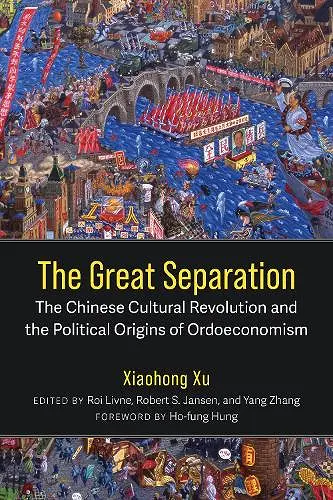
With a keen attention to how culture and elite conflict shape politics, The Great Separation upends deterministic understandings of the Chinese Cultural Revolution and the market reforms that followed. This ambitious posthumous volume by sociologist Xiaohong Xu turns the existing scholarship on China’s “neoliberalism” on its head by demonstrating that the effort to separate mass politics from economic policy had its origins well before the Reform and Opening-up era.
Over the course of the Cultural Revolution, unfolding factional dynamics and interpretive struggles enabled Chairman Mao and his radical colleagues to mobilize workers to advance their own political goals while neutralizing the masses’ economic demands, symbolically separating the political from the economic. This set the stage for a more thoroughgoing depoliticization of the economy after 1989, when China faced challenges from students and workers whose economic grievances had rapidly morphed into political demands for democracy. The result was what Xu calls ordoeconomism: an ideology that valorizes economic development, rejects mass politics, and views the state as the apolitical guardian of the economy. As Xu demonstrates, while ordoeconomism may share some affinities with neoliberalism, it is a distinctively Chinese approach that must be understood on its own terms.
“The Great Separation advances a conceptual framework and set of insights that will fundamentally reshape future scholarship on the Cultural Revolution and China’s post-revolutionary market reforms.”
-- Yiching Wu, University of Toronto“Students of revolution and China’s Cultural Revolution will find these three pieces invaluable. Xiaohong reexamines revolutions as often unintended transformations shaped by dialogic struggle between elites and the masses and by agents’ recognition of ‘new time’ with new opportunities. His original analysis of ordoeconomism will undoubtedly inspire further work on the separation of mass politics from material improvement.”
-- Juan Wang, McGill University“Always reaching past the received wisdom, but with his feet anchored in historical sources, the late Xiaohong Xu’s work challenges Western social theory and revises modern Chinese history. His concluding essay on “the great separation” of politics and economics unearths a paradoxical affinity between the Cultural Revolution in China and the Neoliberal Revolution in the Anglosphere. A tour de force.”
-- Philip Gorski, Yale University“We are fortunate to have the late Xiaohong Xu’s bold and adventurous writings on China’s Cultural Revolution gathered in this volume, beautifully edited by Livne, Jansen and Zhang. How did the politics of interpretive struggle among Mao, party officials, and the rebellious students shape the Cultural Revolution? Why was this foundational for China’s late 20th and early 21st-century ordoeconomism? Readers will find novel and persuasive answers in The Great Separation, informed by Xu’s agile integration of a spectacularly wide range of social theory and historical dynamics.”
-- Julia Adams, Yale UniverISBN: 9780472058341
Dimensions: unknown
Weight: unknown
160 pages