A Beautiful Fight
The Racial Politics of Capoeira in Backland Bahia
Format:Hardback
Publisher:The University of Michigan Press
Published:28th Jul '25
£68.95
Supplier delay - available to order, but may take longer than usual.
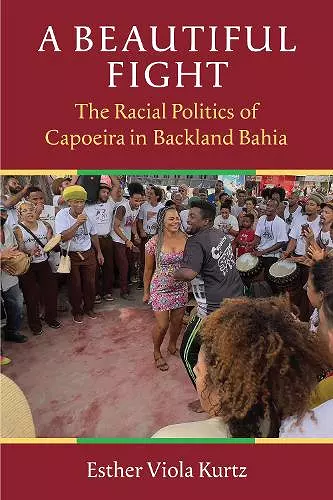
A Beautiful Fight examines the potentials and limits of capoeira Angola to cohere a multiracial community committed to antiracist struggle. Capoeira, a musical fight-game that originated among enslaved Africans in Brazil, holds special significance for Black Brazilian activists as a spiritual and political practice that affirms the value of Black lives, thus countering anti-Black violence sanctioned by the Brazilian state. However, many capoeira groups count more white practitioners than Black, especially groups of the politicized, Afrocentric style capoeira Angola, raising debates about appropriation of Black culture that resonate across the Americas. A Beautiful Fight addresses these tensions. Drawing on ethnographic research with a multiracial capoeira Angola group in Brazil’s Bahian sertão or backlands, Esther Viola Kurtz explores diverse group members’ understandings of capoeira’s spiritual and political meanings and considers how white participation impacts capoeira’s antiracist politics. A Beautiful Fight argues that white practitioners occupying space in capoeira divert attention from Black members’ concerns and reproduce racist and colonialist ideologies, albeit unintentionally. In this way, the book complicates claims that shared music and dance bridge differences and facilitate cross-racial unity, yet Kurtz proposes that capoeira still transmits knowledge and tools that, when used with intention, commitment, and care, can be wielded to collaboratively contest racism and imagine a more just world.
"A Beautiful Fight: The Racial Politics of Capoeira in Backland Bahia provides a rich and deeply felt analysis of Afro-Brazilian capoeira as an example of the power of music and dance in the antiracism struggle. Kurtz brilliantly paints a complex portrait of embodied Black resistance against white supremacy and colonialism, providing a necessary corrective to the idea that cultural dominance correlates to Black inclusion in the Brazilian national polity. This book is a must-read for scholars of race relations and cultural politics in Brazil and the broader African diaspora."
-- Keisha-Khan Y. Perry, author of Black Women against the Land Grab and the Fight for Racial Justice in Brazil“Kurtz’s A Beautiful Fight is an important and timely contribution to existing capoeira scholarship. The author offers a fresh perspective with her rigorous application of hemispheric Black feminist theory. This accessible and beautifully written book will be of interest not only to scholars and students but also practitioners of capoeira Angola and anyone interested in Black culture in Brazil.”
-- Katya Wesolowski, author of Capoeira Connections: A Memoir in Motion“A Beautiful Fight delves into some of the most complex ethical and political issues surrounding multiracial engagement in a tradition so strongly linked to Black identity, particularly within a society that continues to privilege mixed-race ideals. Writing as a white practitioner, Kurtz adopts a community-based approach to examine racial dynamics in capoeira as practiced in rural Bahia, highlighting both the challenges and the transformative possibilities of its cross-racial resonance.”
-- Christopher Dunn, author of Contracultura: Alternative Arts and Social Transformation in Authoritarian Brazil“Through an excellent ethnographic study of a multiracial group in Bahia called the Angoleiros do Sertão, Kurtz offers detailed perspectives on colonialism, appropriation, access, solidarity, and the ever-elusive arcs and promises of liberation. It is clearly important, Kurtz reminds us, to critique (among other tropes and tendencies) white participants’ reproduction of racist and colonialist ideologies in capoeira Angola, while recognizing that these limitations do not foreclose opportunities for cross-racial collaboration on developing more liberatory ways of knowing, being, and acting. “
-- William Cheng and Andrew Dell'Antonio, Music and Social Justice series co-editors“Even with the changes in capoeira that the study raises, Kurtz argues for the potential of capoeira Angola to resolve racial injustices and promote a larger sense of community in Brazil. This is a well-researched volume. Summing Up: Recommended.”
-- K. D. Jackson, ChISBN: 9780472077540
Dimensions: unknown
Weight: unknown
238 pages