Theory and Measurement
Causality Issues in Milton Friedman's Monetary Economics
Format:Paperback
Publisher:Cambridge University Press
Published:10th Nov '05
Currently unavailable, and unfortunately no date known when it will be back
This paperback is available in another edition too:
- Hardback£120.00(9780521552059)
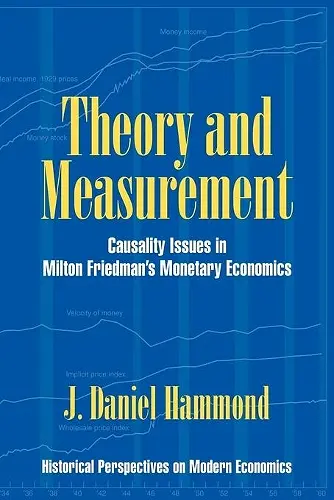
This 1996 work examines the history of debates between Friedman and his critics over money's causal role in business cycles from 1948 to 1991.
Focusing on the period of Milton Friedman's collaboration with Anna J. Schwartz, from 1948 to 1991, this 1996 work examines the history of debates between Friedman and his critics over money's causal role in business cycles. Professor Hammond shows that critics' reactions were grounded in two distinctive features of Friedman and Schwartz's way of doing economic analysis - their National Bureau business cycle methods and Friedman's Marshallian methodology. With the post-war dominance of Cowles Commission methods and Walrasian methodology, Friedman and Schwartz's monetary economics appeared to contemporary critics to be 'measurement without theory'. Drawing extensively upon unpublished materials, Professor Hammond's treatment offers new insights on Milton Friedman's attempts to settle debates with his critics and his eventual recognition of the methodological impediments. The book will interest monetary economists and macroeconomists, as well as historians of economics and methodologists.
'… I consider the overall scientific quality of the book excellent. Any scholar of the history of the twentieth-century macroeconomics will find it stimulating.' History of Economic Ideas
ISBN: 9780521022644
Dimensions: 229mm x 154mm x 16mm
Weight: 381g
252 pages