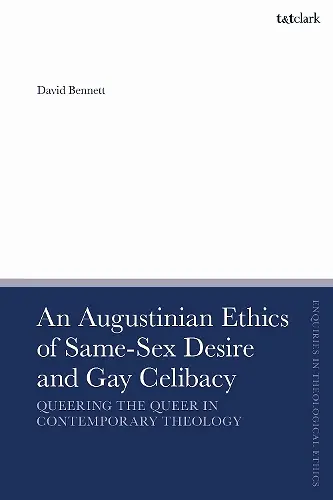
An Augustinian Ethics of Same-Sex Desire and Gay Celibacy
Queering the Queer in Contemporary Theology
Format:Hardback
Publisher:Bloomsbury Publishing PLC
Publishing:18th Feb '27
£85.00
This title is due to be published on 18th February, and will be despatched as soon as possible.
An Augustinian and constructive account of gay celibacy which challenges contemporary Anglican and theological thought on same-sex desire and asceticism.
In this perceptive work, Bennett explores gay celibacy as a positive erotic witness in the contemporary discussion of human sexuality and queer theological discourse. With the recent publication of statements and prayers for blessing from Roman Catholic and Anglican churches, being gay and celibate are together intensely queer realities. They are, however, curiously side-lined in ecclesial ethics, queer and contemporary theologies. Through a constructive analysis of Augustine and Richard Hooker, and contemporary theologians, Oliver O’Donovan, Sarah Coakley, Graham Ward, this book proffers a theological basis for gay celibacy.
In Bennett’s formulations, gay celibacy becomes a Christ-like exclusion from the created good of marriage for the sake of a greater inclusion in its eventual transformation; he also re-examines it as a form of sacramental existence that, due to its exclusion, enjoys greater intimacy and inclusion with Christ in his death and resurrection. As a robustly trinitarian asceticism, this book argues that gay celibacy can be understood as a ‘new asceticism’ which calls gay affectivity to a theological and transformative renewal. By positing such a new asceticism, this book incisively challenges the contemporary field of queer theology. Not only does Bennett open up a new space to articulate a rarely seen love for God, but he also reveals a substantive theology of God’s love and its relationship to human desire.
Celibacy, David Bennett wants to tell us, is an authentic "use" of sexual desire, and one that recognises its eschatological meanings in the face of those that are either more destructive or more conformist. His exploration of this reflection through the patristic church charts a path that can be followed fruitfully in relation to same-sex orientation, affirming the character of homosexual desire as a phenomenon of our morally fragile humanity rather than disguising it as marriage or friendship. He lays claim to the Augustinian tradition in a double sense: on the one hand, grounding his argument in some major texts, and on the other exploiting the "eschatological turn” typical of the twentieth-century readings of Augustine. This is perhaps the most serious theological argument on the theme that we have seen, and even those with nothing more to learn on the topic will, I believe, learn something valuable. * Oliver O'Donovan, University of Edinburgh, UK *
This richly thoughtful account of gay celibacy as a specific vocation of ascetically-transformed love cuts across the sharp current divide between liberal and conservative responses to homosexuality and “queerness”. In so
doing it opens up a remarkably illuminating way of re-thinking the Western, Augustinian, heritage on sexuality and marriage, and creatively re-configures this line of approach also through the classic Anglican thinking of Richard Hooker. All Anglicans and Episcopalians currently rent asunder by the gay debates should read this book: it shifts the usual boundaries of thinking into a deeper seriousness about the intrinsic location of these debates within the theologies of creation, incarnation, resurrection and eschatology.
ISBN: 9780567719003
Dimensions: unknown
Weight: unknown
280 pages