Transpatial Modernity
Chinese Cultural Encounters with Russia via Japan (1880–1930)
Format:Hardback
Publisher:Harvard University Press
Published:31st May '24
Should be back in stock very soon
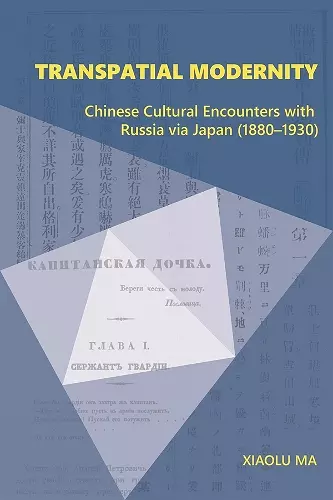
Transpatial Modernity offers the first in-depth account of the triangular relationship among Chinese, Japanese, and Russian literature and culture in the modern era. Drawing on primary sources in all three languages—among others—Xiaolu Ma reveals how Chinese writers translated and appropriated Russian cultural tropes through the intermediary of Japanese writing in the late nineteenth and early twentieth centuries. To trace the global journey of these literatures and ideas, Ma maps four case studies involving leading cultural figures including Leo Tolstoy, Futabatei Shimei, and Lu Xun. Together, they demonstrate the central role of relay transculturation—cultural exchange among at least three cultures, one of which serves primarily as an intermediary—as the key to understanding East Asian modernity. Not limited to a dyadic relationship between source and target culture, Transpatial Modernity explores the implications of cultural brokerage within complex transculturation process, thus establishing the value of a new transpatial framework for understanding literary and cultural exchange in local, regional, and global contexts.
The reader cannot but be impressed by the author’s breadth of the enquiry and depth of intellectual engagement. It is rare to find a scholarly work by someone with such control of sources in four different languages…All in all, this book is a treasure trove of information and insights into the transpatial modernity it presents so well. -- Susan Daruvala * Bulletin of the Institute of Chinese Literature and Philosophy *
Adds to the rich scholarship demonstrating the crucial role of translation in the construction of Chinese cultural modernity. -- Roy Chan * Harvard Journal of Asiatic Studies *
Packaged with an overpowering amount of primary materials and secondary sources, this book is a major study of triangular comparisons and interactions of Russo-Japanese-Sino transculturation across a broad landscape from Pushkin to Lu Xun, all based on the author’s own intimate command of three languages: Russian, Japanese, and Chinese. The author, Xiaolu Ma, writes in a dense but elegant style, whose knowledge of the Russian language gives her a great advantage, as obscure texts appear in refreshing light in this 'trans-space' of modernity. All in all, this 'snapshot' turns out to be a masterful scholarly tome and definitely a major achievement. -- Leo Ou-fan Lee, Professor Emeritus of Chinese Literature, Harvard University
In this very original and theoretically sophisticated study, Xiaolu Ma explores the complex processes of cultural exchange whereby key works of Russian literature were translated into Chinese via Japan. She demonstrates how through triangulation with the Russian and Japanese worlds of letters, a model of modernity was offered to China that was different from that of the West. Using the concept of relay transculturation, and with impressive mastery of three languages, she offers subtle and detailed readings of key works and their translators. -- Stephen Smith, Emeritus Fellow, All Souls College, Oxford University
It is well known that the first reception of Russian literature in China was largely via Japan, but full-scale research has not yet been undertaken. Xiaolou Ma has broken through the language barrier and has accomplished the feat of presenting her research results to the world in sophisticated English, using Russian, Japanese, and Chinese (her native language) sources. It is rare for someone in the humanities to be able to work up to the level of writing a book of this caliber in English. Hats off to the author for her outstanding language skills and her extraordinary effort in completing a large scale cross-cultural and cross-spatial study. -- Mitsuyoshi Numano, Professor Emeritus of Contemporary Literary Studies, University of Tokyo
Her discussion...is particularly instructive in the context of the literary transformations that have taken place in South Asia as a whole. Xiaolu’s command of Chinese, Russian and Japanese is admirable, as she crosses the boundaries of languages and cultures with authority and insight...Xiaolu Ma’s well-researched book demonstrates how multilingual competence can enrich comparative studies of literatures in our times. -- Members of the Jury, the 2025 AILC-ICLA’s Balakian Prize, Honorable Mention
ISBN: 9780674295834
Dimensions: unknown
Weight: unknown
360 pages