Disposable Workers
The Transformation of Employment
Format:Hardback
Publisher:Harvard University Press
Publishing:25th Sep '26
£24.95
This title is due to be published on 25th September, and will be despatched as soon as possible.
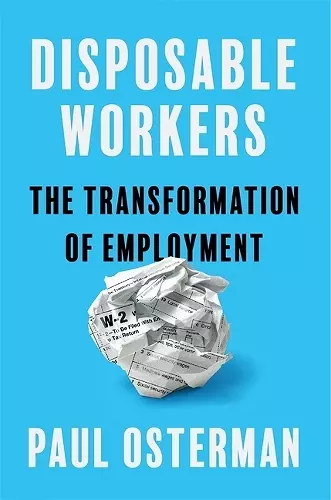
A revealing look at the decline in formal employment in favor of hiring contractors, freelancers, temps, and marginal workers, who are excluded from traditional benefits and career ladders.
Companies cannot exist without workers, but they are increasingly reluctant to have employees. Instead of providing the benefits and protections that have traditionally come with employee status, businesses are turning to tactics that let them treat people as interchangeable parts, to be used and discarded as needed. Drawing on an original survey of over 6,000 workers, Disposable Workers reveals the striking extent of this transformation across the occupational hierarchy, affecting everyone from janitors to nurses.
Paul Osterman identifies three distinct categories of disposable workers: contractors, freelancers, and marginal employees. The marginal category, unique to Osterman’s analysis, describes workers who are employees from a narrow legal standpoint but are held at arm’s length by their firm—left without job security, skill training, or opportunities for promotion. Many low-wage service workers toil in marginal jobs, but so do white-collar professionals such as adjunct university faculty and staff attorneys at law firms. When the three categories are added up, they account for more than 35 percent of the American workforce.
Not all disposable workers object to their arrangements. But most contractors and marginal employees would prefer standard employment, and there is a significant cost to their current status. In response, Disposable Workers offers a range of policy recommendations, including mechanisms to prevent over-reliance on contracting and freelancing as well as reforms to improve job quality for part-timers and marginal employees. As the deconstruction of employment affects more and more workers, the importance of such measures will only grow.
Well-researched, providing valuable quantitative and qualitative analysis of the complex changes in work, Osterman’s book is essential for readers interested in business, employer/employee relations, and labor policy. -- Jane Scott * Library Journal *
Disposable Workers is a deep and important look at a disturbing trend: the unfortunate Uberization of the US economy, in which corporations increasingly regard employees not as valuable assets but as pawns to be casually tossed aside. As Paul Osterman makes clear, companies are offering less and less of what workers need: steady employment with good wages, benefits, and promotions. These corporate practices are badly squeezing millions of Americans. -- Steven Greenhouse, author of Beaten Down, Worked Up: The Past, Present, and Future of American Labor
The decline of unions and the explosion of inequality underlie this prescient and scrupulously documented account of the current and future precarity of the American workforce, and the associated threat this poses to the very foundation of our democracy. Paul Osterman employs his well-honed observations and analytic genius to expose a bifurcated system, whereby a growing number of contract and freelance workers are left to the whims of employers unconstrained by regulations or commitment. A stunning and terrifying cautionary tale. -- Ellen Ruppel Shell, author of The Job: Work and Its Future in a Time of Radical Change
Disposable Workers identifies the profoundly important new development of marginal employees who have no real prospects of stability or career advancement, and who far outnumber the much-discussed ‘gig workers.’ Even at companies we think of as the best employers, the growing ranks of employees who churn through these marginalized jobs is an important and underappreciated factor in the loss of the American Dream. -- Peter Cappelli, author of Our Least Important Asset: Why the Relentless Focus on Finance and Accounting is Bad for Business and Employees
It is tempting to say that Paul Osterman’s greatest contribution in Disposable Workers is the important new survey information he introduces. But what is most impressive is his incisive analysis of what the data—placed alongside a large body of other research and framed in historical context—tells us about work in America today. Osterman paints a picture full of nuance and complexity without ever obscuring the main point: Far too many employers are willing to treat their workers as dispensable as a way to hold down costs and maximize profits. -- Rick Wartzman, author of The End of Loyalty: The Rise and Fall of Good Jobs in America
Disposable Workers is a carefully researched and engaging book documenting the degradation of employment in recent decades. Combining original survey data, insightful analysis of recent literature, and a cornucopia of worker accounts, Paul Osterman provides a counterweight to oversimplified accounts of the ‘future of work,’ shedding new light on the eroding conditions facing millions of workers and the difficult but critical reforms required to address them. -- David Weil, author of The Fissured Workplace: Why Work Became So Bad for So Many and What Can Be Done to Improve It
ISBN: 9780674300248
Dimensions: 210mm x 140mm x 14mm
Weight: 398g
208 pages