Theology After Vedanta
An Experiment in Comparative Theology
Format:Paperback
Publisher:State University of New York Press
Published:2nd Mar '93
Should be back in stock very soon
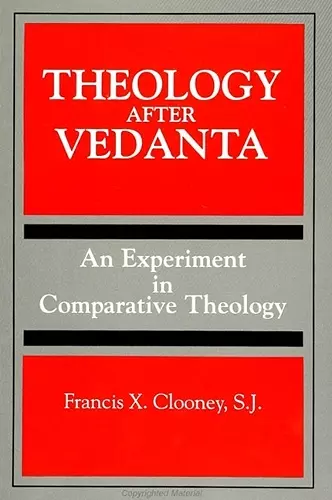
Where Advaita Vedānta, sacred text, and comparative theology meet—truth emerges through the act of reading itself.
What does it mean to read a sacred text so carefully that it changes the reader? In this ambitious and deeply learned work, Francis X. Clooney, S.J., offers an exploration of Advaita Vedānta not as a set of abstract doctrines, but as a disciplined practice of reading—one that forms truth, theology, and the theologian together within the texture of the text itself.
Moving through the Upaniṣads, Śaṅkara’s commentaries, and the Uttara Mīmāṃsā Sūtras, Clooney reveals Advaita as a living, rigorously argued tradition in which meaning emerges through sustained engagement, debate, and commentary. Truth, he argues, is not grasped outside the text or prior to it, but arises after the text—through the transformative participation of a trained and desiring reader. By attending closely to textual structure, reasoning strategies, and interpretive practices, this book reorients how Advaita Vedānta is understood and studied.
The final chapters extend this insight into a bold experiment in comparative theology, placing Advaita Vedānta and Thomas Aquinas’s Summa Theologiae into sustained conversation. Rejecting both superficial comparison and detached theory, Clooney models a form of theological "neighborliness" grounded in fidelity to texts and traditions. The result is a compelling vision of comparative theology as an educational, ethical, and spiritual practice—one that reshapes how truth, doctrine, and interreligious understanding are pursued today.
"In two respects this is a truly original book. First, it elaborates the fundamental truth that people and communities live from the word of scripture, not from doctrines to which scriptures tend to be reduced. Second, this book refuses to take a higher view in theories applied to scriptures. Second, this book refuses to take a higher view in the History of Religions by passing superficially attractive judgments on either Christianity or Hinduism. It does not take sides with either dogmatism or liberalism, and its impartiality is modest. The author does not attack any side; he appreciates, compares, and then seeks such theological illumination as the process of appreciation and comparison warrants.
"The message addressed to Catholic theologians deserves careful attention. My hunch is that history-of-religions scholars, some of whom are former Christians with chips on their shoulders, can learn a lot about just what kind of commitment is necessary to take non-Christian religious traditions seriously.
"I think Clooney's approach holds real promise for interreligious dialogue because it operates from within the setting of an encounter between strange and seemingly incompatible worlds. It refuses to adopt for its point of departure, an imperious general theory about the possible significance that any religion could have. This is an exercise in theological neighborliness, not summitry." — Frans Jozef van Beeck, S.J., John Cardinal Cody Professor of Catholic Theology, Loyola University
"The most important aspect is the recognition and the demonstration that 'Vedanta' as a conceptual scheme cannot be comprehended without knowledge of the presuppositions, postulates, and epistemological instruments of Purva Mimamsa. No one, to my knowledge, ever argued this out properly before Clooney." — Sheldon Pollock, George V. Bobrinskoy Professor of Sanskrit and Indic Studies, and Chair of the Department of South Asian Languages and Civilizations at the University of Chicago
ISBN: 9780791413661
Dimensions: 229mm x 152mm x 18mm
Weight: 399g
284 pages