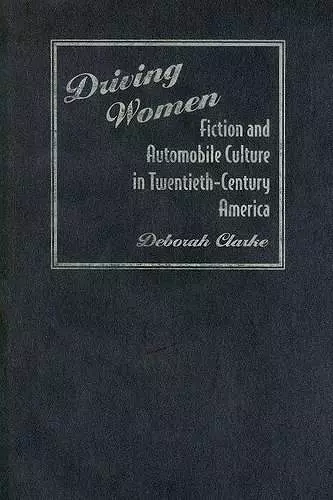
Driving Women
Fiction and Automobile Culture in Twentieth-Century America
Format:Hardback
Publisher:Johns Hopkins University Press
Published:11th May '07
Currently unavailable, and unfortunately no date known when it will be back
An innovative, precise, and useful study. Blending cultural criticism with new readings of texts, Clarke covers a century of American fiction and a century of the history and social impact of the automobile and its advertisements. -- Linda Wagner-Martin, University of North Carolina at Chapel Hill
By investigating how cars can function as female space, reflect female identity, and reshape female agency, this engaging study opens up new angles from which to approach fiction by and about women and traces new directions in the intersection of literature, technology, and gender.Over the years, cars have helped to define the experiences and self-perceptions of women in complex and sometimes unexpected ways. When women take the wheel, family structure and public space are reconfigured and re-gendered, creating a context for a literary tradition in which the car has served as a substitute for, an escape from, and an extension of the home, as well as a surrogate mother, a financial safeguard, and a means of self-expression. Driving Women examines the intersection of American fiction-primarily but not exclusively by women-and automobile culture. Deborah Clarke argues that issues critical to twentieth-century American society-technology, mobility, domesticity, and agency-are repeatedly articulated through women's relationships with cars. Women writers took surprisingly intense interest in car culture and its import for modern life, as the car, replete with material and symbolic meaning, recast literal and literary female power in the automotive age. Clarke draws on a wide range of literary works, both canonical and popular, to document women's fascination with cars from many perspectives: historical, psychological, economic, ethnic. Authors discussed include Wharton, Stein, Faulkner, O'Connor, Morrison, Erdrich, Mason, Kingsolver, Lopez, Kadohata, Smiley, Senna, Viramontes, Allison, and Silko. By investigating how cars can function as female space, reflect female identity, and reshape female agency, this engaging study opens up new angles from which to approach fiction by and about women and traces new directions in the intersection of literature, technology, and gender.
By bringing her expertise in literature and women's studies to bear on automobility, Clarke adds to our understanding of both the lived and the imaginary potential of the automobile in women's lives. -- Kathleen Franz Technology and Culture 2008 Important work. -- Kris Lackey Studies in American Fiction 2008 Astute and thoroughly researched study. -- Laura L. Behling Tulsa Studies in Women's Literature 2008
ISBN: 9780801885501
Dimensions: 229mm x 152mm x 22mm
Weight: 431g
226 pages