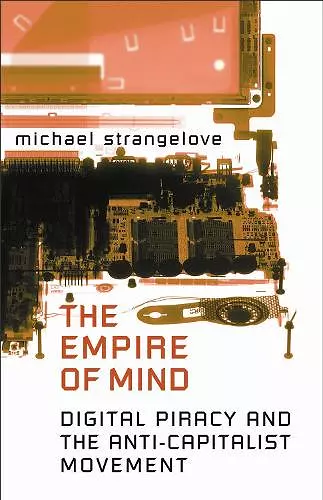
The Empire of Mind
Digital Piracy and the Anti-Capitalist Movement
Format:Paperback
Publisher:University of Toronto Press
Published:18th Sep '05
Currently unavailable, and unfortunately no date known when it will be back
'Michael Strangelove's The Empire of Mind is a highly original, engaging, and challenging book that takes on both conservative apologists for the media and consumer capitalism as well as many leftwing critics who simply see the Internet and new technology as powerful instruments of corporate hegemony. Extremely well written and argued, the book breaks with conventional wisdom and offers provocative and spirited positions on culture jamming, online journalism, and phenomena such as blogging.' -- Douglas Kellner, School of Education and Information Studies, University of California, Los Angeles 'No other book I am aware of argues so effectively, and in such a detailed, nuanced way, the potential of the Internet to undermine the current economic order as does Michael Strangelove's The Empire of Mind. Strangelove is a fine writer and he takes positions seldom articulated. The book makes a substantial contribution to the fields of media and communication studies. I enjoyed it very much and learned quite a bit.' -- Robert Babe, Faculty of Information and Media Studies, University of Western Ontario
In the course of exploring new media, The Empire of Mind also makes apparent that digital piracy will not be eliminated.
Where many critics see the Internet as an instrument of corporate hegemony, Michael Strangelove sees something else: an alternative space inhabited by communities dedicated to anarchic freedom, culture jamming, alternative journalism, and resistance to authoritarian forms of consumer capitalism and globalization. In The Empire of Mind, "Dr. Strangelove," the scholar Canadian Business referred to as the "acknowledged dean of Internet entrepreneurs" and Wired called "the Canadian guru of Internet advertising," presents the compelling argument that the Internet and new digital communication technology actually undermine the power of capital, producing an alternative symbolic economy.
Strangelove contends that the Internet breaks with the capitalist logic of commodification and that, while television produces a passive consumer audience, Internet audiences are more active, creative, and subversive. Writers, activists, and artists on the Internet undermine commercial media and its management of consumer behaviour, a behaviour that is challenged by the Web's tendency toward the disintegration of intellectual property rights. Case studies describe the invention of new meaning given to cultural and consumer icons like Barbie and McDonald's and explore how novel modes of online news production alter the representation of the world as it is produced by the mainstream, corporate press.
In the course of exploring new media, The Empire of Mind also makes apparent that digital piracy will not be eliminated. The Internet community effectively converts private property into public, thereby presenting serious obstacles for the management of consumer behaviour and significantly eroding brand value. Much to the dismay of the corporate sector, online communities are disinterested in the ethics of private property. In fact, the entire philosophical framework on which capitalism is based is threatened by these alternative means of cultural production.
"'Michael Strangelove's The Empire of Mind is a highly original, engaging, and challenging book that takes on both conservative apologists for the media and consumer capitalism as well as many left wing critics who simply see the Internet and new technology as powerful instruments of corporate hegemony. Extremely well written and argued, the book breaks with conventional wisdom and offers provocative and spirited positions on culture jamming, online journalism, and phenomena such as blogging.' Douglas Kellner, School of Education and Information Studies, University of California, Los Angeles; 'No other book I am aware of argues so effectively, and in such a detailed, nuanced way, the potential of the Internet to undermine the current economic order as does Michael Strangelove's The Empire of Mind. Strangelove is a fine writer and he takes positions seldom articulated. The book makes a substantial contribution to the fields of media and communication studies. I enjoyed it very much and learned quite a bit.' Robert Babe, Faculty of Information and Media Studies, University of Western Ontario"
- Winner of Governor General's Award for Non-Fiction 2006 (Canada)
ISBN: 9780802038180
Dimensions: 229mm x 152mm x 23mm
Weight: 560g
320 pages