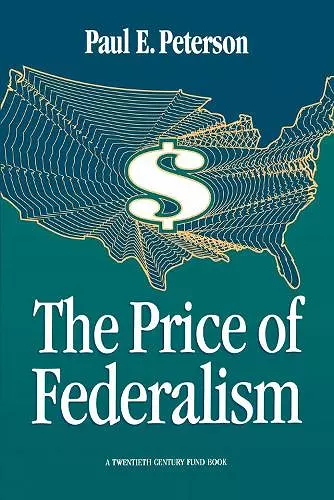
The Price of Federalism
Format:Paperback
Publisher:Bloomsbury Publishing PLC
Published:1st May '95
Currently unavailable, and unfortunately no date known when it will be back
"An informative, even accessible, book that goes to the heart of the current talk about block grants, unfunded mandates, the deficit and more... [A] valuable look at the bottom line of domestic politics" --Publishers Weekly
What is the price of federalism? Does it result in governmental interconnections that are too complex? Does it create overlapping responsibilities? Does it perpetuate social inequalities? Does it stifle economic growth? To answer these questions, Paul Peterson sets forth two theories of federalism: functional and legislative.
What is the price of federalism? Does it result in governmental interconnections that are too complex? Does it create overlapping responsibilities? Does it perpetuate social inequalities? Does it stifle economic growth?
To answer these questions, Paul Peterson sets forth two theories of federalism: functional and legislative. Functional theory is optimistic. It says that each level of the federal system is well designed to carry out the tasks for which it is mainly responsible. State and local governments assume responsibility for their area's physical and social development; the national government cares for the needy and reduces economic inequities. Legislative theory, in contrast, is pessimistic: it says that national political leaders, responding to electoral pressures, misuse their power. They shift unpopular burdens to lower levels of government while spending national dollars on popular government programs for which they can claim credit.
Both theories are used to explain different aspects of American federalism. Legislative theory explains why federal grants have never been used to equalize public services. Elected officials cannot easily justify to their constituents a vote to shift funds away from the geographic area they represent. The overall direction that American federalism has taken in recent years is better explained by functional theory. As the costs of transportation and communication have declined, labor and capital have become increasingly mobile, placing states and localities in greater competition with one another. State and local governments are responding to these changes by overlooking the needs of the poor, focusing instead on economic development. As a further consequence, older, big cities of the Rust Belt, inefficient in their operations and burdened by social responsibilities, are losing jobs and population to the suburban communities that surround them.
Peterson recommends that the national government adopt p
"An informative, even accessible, book that goes to the heart of the current talk about block grants, unfunded mandates, the deficit and more.... [A] valuable look at the bottom line of domestic politics" —Publishers Weekly
ISBN: 9780815770237
Dimensions: 228mm x 153mm x 15mm
Weight: 376g
264 pages