The Voice of Science
British Scientists on the Lecture Circuit in Gilded Age America
Format:Hardback
Publisher:University of Pittsburgh Press
Published:12th Oct '21
Should be back in stock very soon
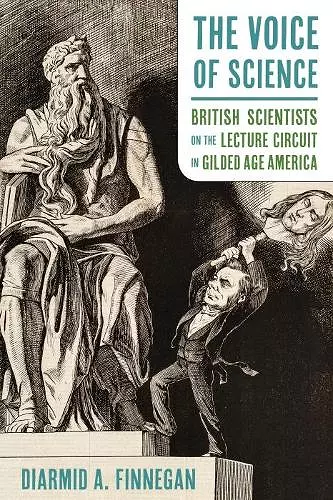
How Five Celebrity Scientists Used the Art of Public Speech to Advocate for Science as a Powerful Agent for Cultural Change
Examines five nineteenth-century British celebrity scientists and their lectures.
For many in the nineteenth century, the spoken word had a vivacity and power that exceeded other modes of communication. This conviction helped to sustain a diverse and dynamic lecture culture that provided a crucial vehicle for shaping and contesting cultural norms and beliefs. As science increasingly became part of public culture and debate, its spokespersons recognized the need to harness the presumed power of public speech to recommend the moral relevance of scientific ideas and attitudes. With this wider context in mind, The Voice of Science explores the efforts of five celebrity British scientists—John Tyndall, Thomas Henry Huxley, Richard Proctor, Alfred Russel Wallace, and Henry Drummond—to articulate and embody a moral vision of the scientific life on American lecture platforms. These evangelists for science negotiated the fraught but intimate relationship between platform and newsprint culture and faced the demands of audiences searching for meaningful and memorable lecture performances. As Diarmid Finnegan reveals, all five attracted unrivaled attention, provoking responses in the press, from church pulpits, and on other platforms. Their lectures became potent cultural catalysts, provoking far-reaching debate on the consequences and relevance of scientific thought for reconstructing cultural meaning and moral purpose.
Diarmid Finnegan’s fascinating and highly readable study brings us up close and personal to the soundscape of the Gilded Age and, in the process, of Victorian Britain. The scholarly labor required to recover that lost soundscape is not for the faint-hearted, and Finnegan impresses in his innovative use of a range of sources—most notably the kinds of news report that helped to create and sustain the lecture circuit—in helping us to hear the echoes of the past.
* Victorian Studies *An impressive scholarly work.
* Archives of Natural History *The Voice of Science is a beautifully written and engrossing book, demonstrating deep analysis of the lectures and lives of these British scientists. It will be of particular interest for scholars working on the key figures highlighted here and for those generally interested in the culture of science in the nineteenth-century Anglo-American world.
* Isis *This superb study by Diarmid Finnegan focuses on British contributors to what was by the 1870s a well-developed lecture circuit in the United States, with a network of agents, advertisements, auditoriums, and newspaper reports that supported talks on just about any subject one could imagine. Finnegan provides an illuminating guide to this vital arena for promoting the natural sciences.
* British Journal for the History of Science *Diarmid Finnegan’s eloquent book traces the itineraries of British men of science on the American lecture circuit in the second half of the nineteenth century. Drawing on deep archival research, he allows us to witness the performances of such luminaries as Tyndall, Huxley, and Wallace, who gave a voice to science while inadvertently stirring religious and political controversy.
-- Jan Golinski, University of New HampshireThe Voice of Science is a fascinating account of popular science lectures and lecturers in nineteenth-century Britain and America. Finnegan writes with a clarity, liveliness, and poise that the subjects of this book would have appreciated. It is crucial reading for historians, geographers, sociologists, and others interested in the performance, affective power, and cultural meanings of science.
-- Simon Naylor, University of GlaISBN: 9780822946816
Dimensions: unknown
Weight: unknown
300 pages